

Yes, you can use gift money toward a Texas home purchase. Most mortgage programs accept gifts for the down payment and closing costs, provided the donor is an acceptable person, the money is a true gift with no repayment, and the transfer can be traced from the donor’s account to yours or to the closing agent. Texas has no state gift tax, and the federal rules rarely create a bill for the person on the receiving end.
I work with Austin-area buyers in Cedar Park, Round Rock, Georgetown and the city itself, and the same few mistakes slow down gift-funded files: a vague donor relationship, a deposit nobody can explain, and a letter missing one required line. This guide walks through each so your underwriter has nothing to question.
TL;DR
- Gifts are allowed on conventional, FHA, VA and USDA loans, but the donor list and paperwork differ by program, so confirm with your loan officer before any money moves.
- Conventional loans cap who can give (mainly relatives and close personal relationships), and the donor cannot be the builder, agent or another party with a stake in the sale.
- Every gift needs a signed letter stating the amount and that no repayment is expected, plus a paper trail of the transfer.
- Texas does not tax gifts. Federally, the donor handles any filing, and the 2026 annual exclusion is $19,000 per recipient.
- Move the money early. A late, unexplained deposit is the most common cause of underwriting delays.
Table of Contents
- What counts as gift funds on a Texas mortgage
- Who can give you the money
- Rules by loan type at a glance
- What the gift letter must say
- Proving the money moved
- Timing: when to move the gift
- Gift tax: what Texas and the IRS require
- Can a gift pay off an existing mortgage?
- Perspective
- Plan your gift-funded purchase with ATXCasa
- Common mistakes to avoid
- FAQ
- Sources
What counts as gift funds on a Texas mortgage
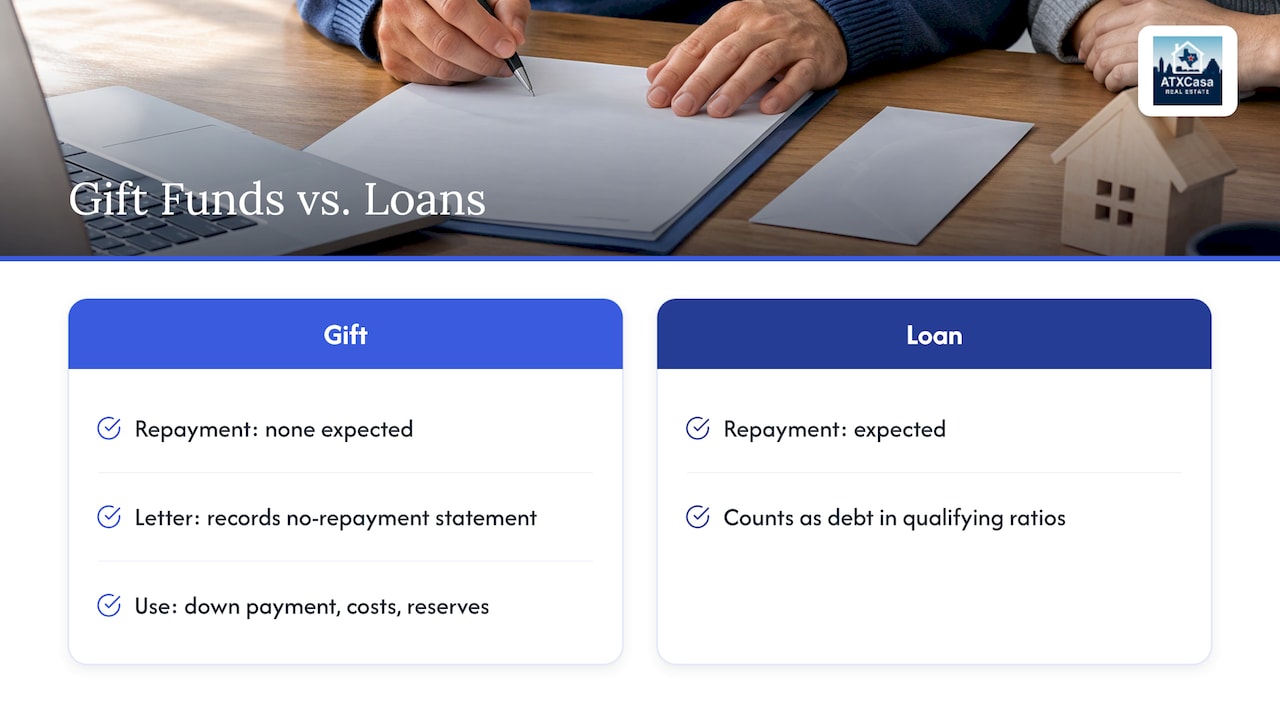
Gift funds are money given to you for your purchase with no expectation of repayment. The Texas State Affordable Housing Corporation (TSAHC) says that a gift may be used for a required down payment if it comes from a relative, a co-borrower, or a nonprofit or government organization such as TSAHC itself, and it adds that lender requirements may differ by loan.
The key word is gift. If the person expects to be paid back, even informally, it is a loan, and it counts as a debt in your qualifying ratios. A gift letter is how you put the “no repayment” statement in writing.
Gift money can serve three purposes, depending on the program: the down payment, closing costs, and financial reserves. Fannie Mae, for example, permits personal gifts for a principal residence or second home to fund all or part of the down payment, closing costs or reserves, but not for an investment property. Freddie Mac takes the same position: gift funds or a gift of equity for a primary residence or second home, not an investment-property mortgage.
That last point matters to investors. If you plan to buy a rental in Round Rock or Georgetown, a family gift generally cannot be your source of funds on a conventional investment-property loan.
Who can give you the money
The donor rules are where loan types diverge most.
Conventional loans
Under Fannie Mae’s definition, eligible donors include relatives by blood, marriage, adoption or legal guardianship. The list also covers a domestic partner or the partner’s relative, a fiancé, a former relative, or a person with a long-standing, familial-like or mentorship relationship. The full donor definition is in the Selling Guide.
Fannie Mae also bars a donor who is, or is affiliated with, the builder, developer, real estate agent or another interested party. A seller may donate only when the seller is also an acceptable donor and is not otherwise affiliated with an interested party.
In practice: your parents, siblings, grandparents, fiancé or an aunt are straightforward. A friend, a coworker or your agent is not.
FHA loans
FHA is the broadest. Retrieved guidance on FHA lists family members, employers or labor unions, close friends with a clearly defined and documented interest in the borrower, charitable organizations, and governmental or public homeownership-assistance entities as acceptable sources. If you are buying a primary residence with FHA financing, you should also know how appraisers treat the roof, which is covered in this overview of FHA roof inspection requirements.
VA and USDA loans
For VA loans, the donor cannot be an interested party such as a builder, developer, real estate agent, broker or anyone else with a financial stake in the transaction, according to lender guidance. USDA loans generally allow gift funds as long as the donor has no financial interest in the transaction, and they allow 100% financing with no required down payment, per NerdWallet. Because USDA and VA buyers often need little or no down payment, gifts mostly help with closing costs and reserves.
Texas assistance programs
Gift funds can also come from a nonprofit or government source. The Texas Department of Housing and Community Affairs describes its designated-area gift funds as one-time gifts usable toward customary down payment and closing costs only with specified program options and in eligible counties or cities. Cash back to the borrower is not allowed for the gift portion. These details sit in the TDHCA Lender Guide, effective November 1, 2026. For a broader look at what is available, see our guide to Texas first-time homebuyer assistance programs.
Rules by loan type at a glance
| Loan type | Typical donors | Can gift cover the whole down payment? | Key restriction |
|---|---|---|---|
| Conventional (Fannie Mae) | Relatives, partners, fiancé, close familial-like relationships | Yes, at 80% LTV or less on a one- to four-unit primary or second home | No gifts for investment property; no interested-party donors |
| Conventional (Freddie Mac) | Qualifying relationship stated in the letter | Yes for a primary residence | Second home above 80% LTV needs at least 5% from personal funds |
| FHA | Family, employers, close friends with documented interest, charities, public agencies | Yes on a primary residence | Donor relationship must be documented |
| VA | Donor not an interested party | Often little or no down payment is needed | No builder, agent or broker donors |
| USDA | Donor with no financial interest | 100% financing available | Donor cannot have a stake in the sale |
Two rules from the table deserve a closer look.
Fannie Mae at 80% LTV or less. LTV is the loan amount compared with the property value or purchase price used by the lender. Under Fannie Mae’s guide, when the applicable loan-to-value ratios are 80% or less, no contribution from your own funds is required for a one- to four-unit principal residence or second home, so everything you need to close may come from a gift. Above 80%, a one-unit principal residence still has no minimum contribution from your own funds. A two- to four-unit principal residence or a second home requires 5% from your own funds. After any required contribution, gifts may supplement the down payment, closing costs and reserves. Your lender may impose additional requirements.
Freddie Mac second homes. When the LTV, TLTV or HTLTV ratio is above 80%, the borrower must put down at least 5% from personal funds. If you are buying a vacation or lake property, also read up on vacancy rules and second home insurance so the property is properly covered once you own it.
A single-family primary residence is the cleanest case: gift money can cover the full down payment.
What the gift letter must say
The letter is short, but every item has to be there. Freddie Mac’s requirements, laid out in its Seller/Servicer Guide, are a good checklist, and most lenders ask for the same content:
- The gift amount.
- A statement that no repayment is required.
- The donor’s name and relationship to you.
- The donor’s mailing address and telephone number.
- The donor’s signature.
Many lenders provide their own template, so ask your loan officer for it instead of writing one from scratch. If your lender’s form differs from a template you found online, use the lender’s.
Name the property or loan only if the lender’s form asks for it, and make sure the amount on the letter matches the amount that actually moves. A letter for $20,000 with a $17,500 transfer creates a question you will have to answer in writing.
Proving the money moved
The letter says the money is a gift. The bank records prove it arrived. Freddie Mac accepts evidence such as donor and borrower bank statements, a canceled gift check, withdrawal and deposit slips, or a cashier’s check or wire confirmation. The same guide also allows these transfer paths:
- Donor to borrower.
- Donor to the closing agent (the title company, in a Texas transaction).
- For earnest money, donor directly to the builder or real estate agent.
Third-party money-transfer services are acceptable only when the file proves the transfer came directly from the donor’s bank account. Cash is the weakest option. An unexplained cash deposit into your account is hard to document, and underwriters will ask where it came from.
If the donor is wiring money to the title company, ask the title company for wire instructions by phone at a number you already trust, and have the donor confirm them the same way. Wire fraud targeting closings is real, and a gift sent to the wrong account is not recoverable by anyone’s paperwork.
Keep the trail clean
A lender-published guide recommends that you discuss the gift with your loan officer before any transfer, finish the letter and the traceable transfer early, and avoid last-minute deposits, because verification can delay underwriting. A good habit is to build a single folder with the signed letter, the donor’s statement showing the withdrawal, and your statement showing the deposit. Our guide to avoiding delays from a late or unexplained transfer is not a substitute for your lender’s checklist, but the principle is the same: documents first, then money.
Timing: when to move the gift
There is no single deadline across every loan, so the practical answer is: as early as your lender allows. Money that sits in your account before you apply is usually the simplest to document, because it appears on the statements the lender reviews anyway. Money that lands during underwriting needs its own letter and its own trail.
Here is the sequence I recommend:
- Tell your loan officer who plans to give, how much, and for which purpose (down payment, closing costs, reserves).
- Ask which donor and documentation rules apply to your loan program.
- Have the donor sign the lender’s letter.
- Transfer the funds, by wire or check from the donor’s account, and save both statements.
- Send everything to your lender the same day.
- Avoid any new unexplained deposits until closing.
For earnest money in an Austin contract, remember that the option period and earnest-money deadline run fast. If a donor is covering earnest money, set up the transfer path before you write the offer. As noted above, the donor can send earnest money directly to the builder or agent under Freddie Mac’s rules.
Gift tax: what Texas and the IRS require
Texas has no state gift tax on transfers of cash or real property, according to a Texas tax resource. The federal rules apply, and they fall on the donor, not on you.
For 2026, the annual exclusion is $19,000 per donor per recipient, and a married couple can generally give $38,000 per recipient by using two exclusions. If a gift is larger, the donor generally files IRS Form 709. Filing a return does not mean tax is due: the excess generally just reduces the donor’s remaining lifetime exclusion, per the same tax guidance. The federal estate tax exemption is $15 million in 2026, so most families will never owe federal gift tax.
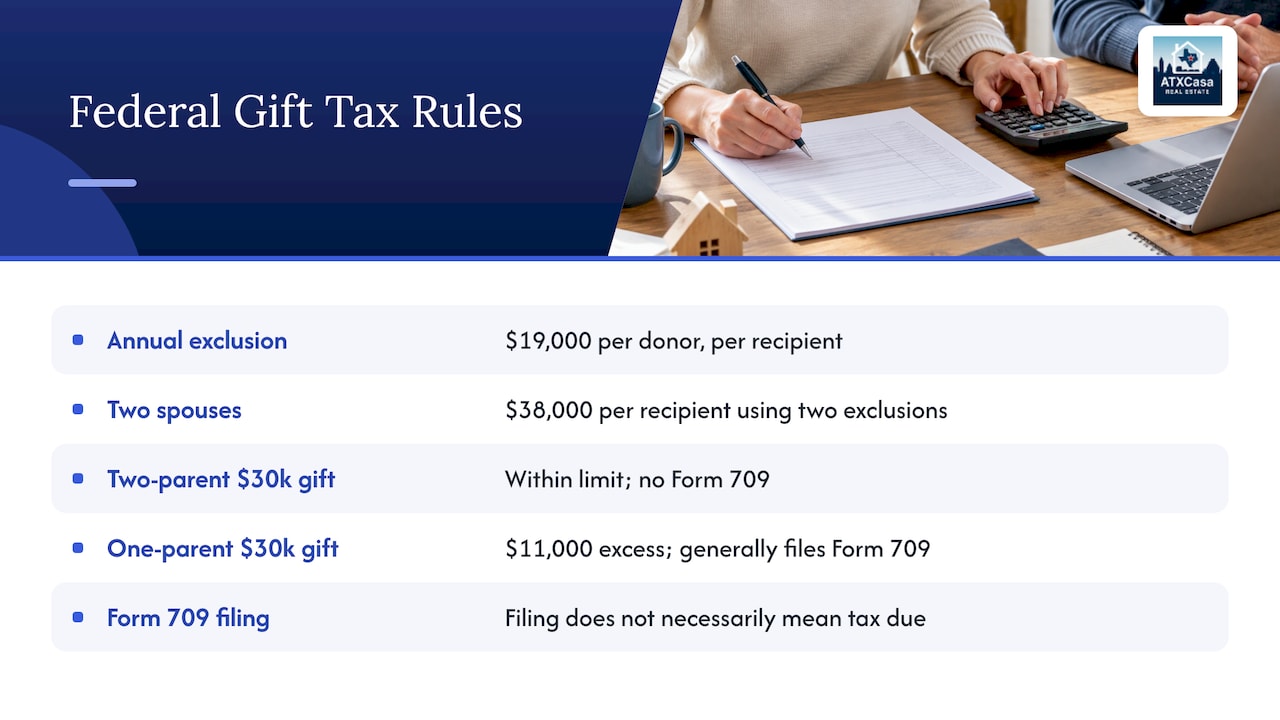
A worked example: your parents give you $30,000 toward a house in Cedar Park. Each parent can use a $19,000 exclusion, so $38,000 combined fits within the annual limit and requires no Form 709. If only one parent gives the full $30,000, that parent exceeds $19,000 by $11,000 and would generally file Form 709, with no tax due. Donors should confirm their own situation with a CPA, since the reporting is theirs.
Can a gift pay off an existing mortgage?
A gift toward an existing mortgage balance is a different situation from a gift toward buying a home. Mortgage gift-letter rules are written around purchase and refinance funds being verified, so a lender is not usually asking about a family member sending money to your servicer. The federal gift-tax rules above still apply to the donor, since the amount is a gift whether it goes to a down payment or a loan balance. If a gift is part of a refinance you are applying for, tell your loan officer what the lender will want documented. If you are simply paying down a balance, a CPA can tell your donor how to report it.
Perspective
We see gift funds as one of the cleanest ways for a first-time buyer in Austin to close the gap between savings and a down payment, and we see them go wrong for one reason: the paperwork was started after the money moved.
Our approach comes from my background in IT: treat the file like a data set. Decide who the donor is, which loan program applies, and what each document must show before anything is transferred. When a buyer starts that way, the underwriter reads a consistent story from the letter to the bank statements, and the file moves.
We also look at gifts alongside other sources of help. A gift can sit next to a state or local assistance program, and the right combination depends on your loan, your price range and your monthly budget. We compare those options with real numbers from the Austin area, not with generic national averages.
My read: if a family member is willing to help, talk to a lender first, then to the donor. That order saves more time than any other single step.
Vladimir
Plan your gift-funded purchase with ATXCasa
If you are weighing a gift against other forms of help, we can walk through the choices with Austin-area numbers. Start with our guide to Austin down payment assistance, which explains how to choose a lender with experience in these programs.

When you are ready to talk through your own purchase, reach out through ATXCasa. We cover buying, selling and investing in Austin, Cedar Park, Round Rock and Georgetown. For first-time buyers, our Austin first-time buyer guide covers offer tactics and assistance in more detail.
Common mistakes to avoid
- Using the wrong donor. A friend or coworker may not qualify on a conventional loan. Check the list before you accept.
- Accepting money from an interested party. Under Fannie Mae’s guide, a builder, developer, real estate agent or other interested party cannot be a gift donor. A seller can be an exception only if the seller is also an acceptable donor and is not affiliated with any other interested party. Confirm the applicable program’s rule with your lender before funds move.
- Vague letters. Missing relationship, amount or signature lines get letters sent back.
- Cash deposits. Without a withdrawal record from the donor, there is nothing to match.
- Gift on an investment property. Conventional guidelines do not allow it.
- Skipping the lender call. Rules differ by program and by lender overlay, so the first conversation should be with your loan officer.
FAQ
Can my parents gift me $30,000 for a down payment?
Yes, if they are acceptable donors for your loan and the money is a true gift. For federal tax, each parent has a $19,000 annual exclusion in 2026, so $30,000 split between two parents needs no Form 709. If one parent gives it all, that parent would generally file the form, with no tax due in most cases.
Does Texas have a gift tax?
No. Texas does not tax gifts of cash or real property. Federal gift-tax rules still apply to the donor, and the recipient generally owes nothing.
What is a mortgage gift letter?
It is a signed statement from the donor confirming the amount and that no repayment is required. Freddie Mac’s version also includes the donor’s name, relationship, mailing address and phone number, per its Seller/Servicer Guide. Your lender usually supplies the form.
Can a friend give me gift money for a mortgage?
It depends on the loan. Conventional rules focus on relatives and familial-like relationships. FHA allows close friends with a clearly defined and documented interest in the borrower. Ask your lender before your friend sends anything.
Sources
- TSAHC: Is a Gift an Acceptable Source of my Down Payment?
- TDHCA Lender Guide
- Fannie Mae Selling Guide: Personal Gifts
- Freddie Mac Seller/Servicer Guide, section 5501.4
- HSH: How to Use Gift Money for Down Payment
- Wells Fargo: Using gift funds for your down payment
- NerdWallet: Gift Letters for Mortgages
- NerdWallet: Gift Tax, 2026 and 2027 Exclusions and Limits
- American Century: Rules for Gifting Money to Family for a Down Payment
- Texas Gift Tax: What You Owe and File
- Adams Bank & Trust: Using Gift Funds for a Down Payment
- FHA roof inspection requirements
- Second home insurance and vacancy rules
- Avoiding delays from a late or unexplained transfer