
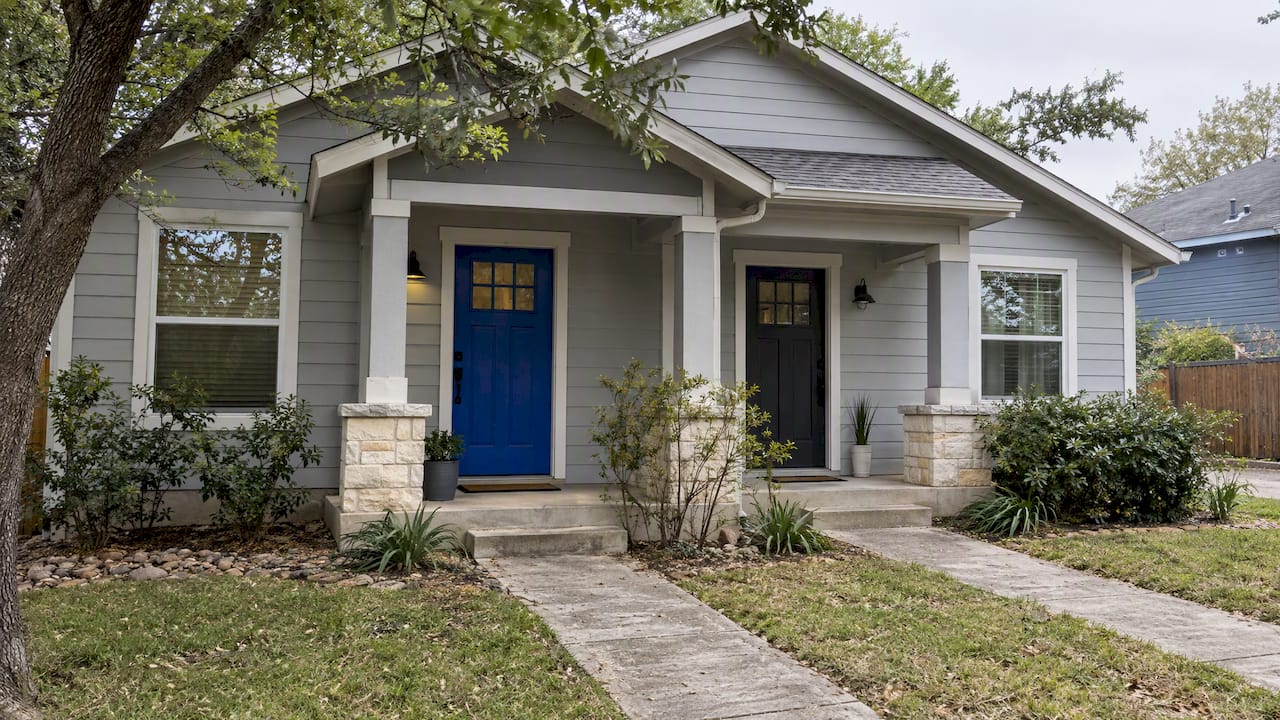
House hacking in Austin means buying a home you will live in, then renting out part of it (a second unit, a spare room, or a backyard ADU) so that tenant income covers part of your housing cost. It can lower the real cost of owning in a pricey market. It also makes you a landlord, so the deal only works if the numbers hold when things go wrong. Below I walk through the property types, the financing, a worked example, the local rules, and the risks, the way I would with a client.
TL;DR
- House hacking is owner-occupancy plus rental income: you live in one unit and rent the others, or rent a room or floor of a single-family home.
- FHA loans allow down payments as low as 3.5% on eligible one-to-four-unit properties, but closing costs and reserves are separate from the down payment.
- Underwrite with verified, executed rents and a full expense list. Make sure you could carry the mortgage with no tenant income at all.
- In Austin, check the lot, the ADU rules and the short-term rental licensing rules before you offer, not after closing.
Table of Contents
- What house hacking means in Austin
- Common ways to house hack in Austin
- Financing a house hack
- Running the numbers: a worked example
- What drives rental demand and house-hacking potential in Austin
- Austin rules and landlord responsibilities
- Risks and how to prepare
- Our perspective
- Work with ATXCasa on your house hack
- FAQ
- Sources
What house hacking means in Austin
The idea is simple. You buy a property, live in part of it, and rent the rest. Amplify Credit Union describes it as buying a multifamily property as your primary residence and renting the other units, or renting a room or floor of a single-family home. The difference from a conventional investment property is that you live there too, which changes how lenders treat the loan and how you experience the risk.
The goal varies by buyer. Some want tenants to cover the whole mortgage. Most realistic first deals aim for something more modest: rent covers a meaningful share of the payment, taxes and insurance, and the owner’s remaining cost is closer to what a renter would pay. I would rather you plan for the modest outcome and be pleasantly surprised.
Common ways to house hack in Austin
Austin’s housing stock gives you several routes. Each has a different cost of entry and a different level of day-to-day involvement.
Rent rooms in a single-family home
This is the lowest-friction path. You buy a house with extra bedrooms, ideally with a second living area or a bathroom that can be used separately, and rent rooms to roommates. You avoid building anything, and you can stop renting if your situation changes. The tradeoff is privacy and the fact that room rents are usually lower per square foot than a whole unit.
Buy a duplex, triplex or fourplex
Living in one unit of a two-to-four-unit building is the classic structure. Financing for one-to-four-unit owner-occupied properties is available on low-down-payment terms, and each unit has its own kitchen and entrance, so the arrangement feels more like a landlord and tenant relationship than a roommate one. Multi-unit properties in central Austin tend to cost more per door than in the suburbs, so compare the surrounding areas of Round Rock, Cedar Park and Georgetown as well as the urban core.
Add or use an accessory dwelling unit (ADU)
A home with a garage apartment, a backyard cottage or a legal second unit gives you a separate rental without sharing walls with a roommate. You can buy a property that already has one, or build one after purchase. Building adds cost and time, and the lot has to qualify. I cover the main checks in our guide to Austin ADU rules under HOME, and I would read it before putting an offer on any lot where you are counting on a future ADU.
Rent part of the home short term
Some owners consider renting a room or a unit on a short-term basis. In Austin this is the option with the most regulatory friction, so I treat it as a bonus rather than the base case. More on that in the rules section below.
Financing a house hack
Financing is the reason house hacking appeals to first-time buyers. Because you will occupy the property, you can often use owner-occupant loan programs instead of investor loans, which typically ask for larger down payments.
Down payment options
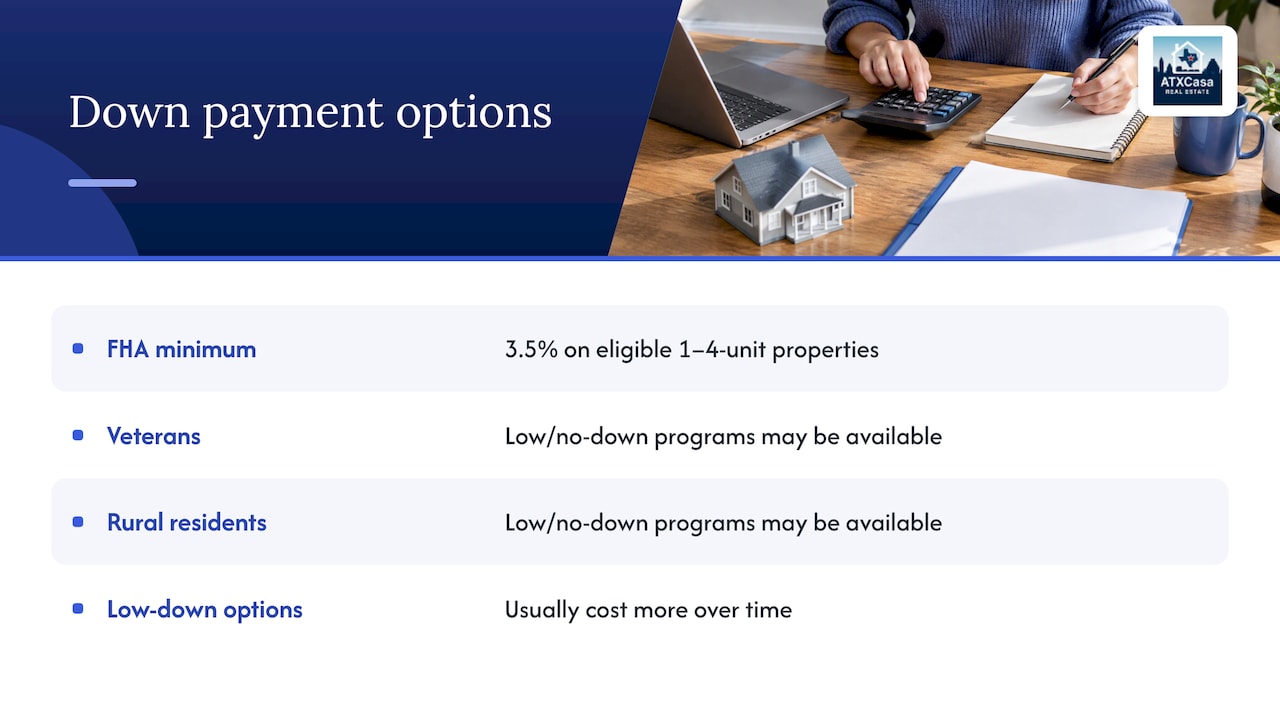
HUD says FHA down payments can be as low as 3.5% on eligible one-to-four-unit properties. The Consumer Financial Protection Bureau also notes that low- or no-down-payment programs may be available to veterans and rural residents, and that low-down-payment options usually cost more over time. Whether a specific loan fits your deal depends on your credit, your income, the property and the lender’s current guidelines, so get a pre-approval in writing from a lender before you shop for multi-unit properties. Ask the lender specifically how it will count rental income from the other units, because lenders differ on this.
Costs beyond the down payment
The down payment is only part of what you need at closing. The CFPB advises that you estimate closing costs separately, typically 2% to 5% of the purchase price, and then keep an emergency cushion of at least three to six months of expenses, plus money for moving, repairs and setup. For a house hack, I would lean to the higher end of that cushion, since you are carrying a property that can produce unexpected repairs and a vacancy at the same time.
Running the numbers: a worked example
The example below is hypothetical. It shows the method, not a prediction for any particular property. Replace every figure with quotes, tax bills and rent evidence from the actual deal.
Assume a $500,000 duplex where you live in one side and rent the other.
| Item | Hypothetical figure |
|---|---|
| Purchase price | $500,000 |
| Down payment at 3.5% | $17,500 |
| Closing costs at 2% to 5% | $10,000 to $25,000 |
| Cash needed before reserves | $27,500 to $42,500 |
| Reserve at three to six months of expenses | Depends on your monthly spending |
The upfront cash arithmetic comes straight from the percentages above. Now monthly costs. Effective underwriting accounts for the mortgage, taxes, insurance, maintenance, HOA fees and property management. A decent worksheet has these lines:
- Principal and interest on the loan
- Property taxes (Austin-area bills are large, so use the actual figure from the county rather than a rule of thumb)
- Homeowners insurance
- Mortgage insurance, if your loan requires it
- Maintenance and repairs set aside monthly
- HOA dues, if any
- A vacancy allowance
- Management cost, even if you plan to self-manage, because your time has a value and you may eventually hire help
Then compare against rent. Driven Property Management advises basing the projection on verified, executed market rents rather than listing prices or online estimates, since every downstream figure depends on that number. I agree with that. Asking rents on listing sites are what owners hope for. Executed leases tell you what tenants actually pay.
The number I care about most is your net monthly housing cost: the full payment and operating costs, minus conservative rent. Then run a second version with the rent set to zero. If you can live with that second version for several months, the deal is resilient.
Thinking about the property’s best use also helps. Some buyers find a useful frame in this walkthrough of highest and best use analysis, which tests whether a property’s potential use is physically possible, legally allowed, financially feasible and the most productive. Apply the same discipline to a lot: what can legally be rented here, what will it earn, and what does it cost to get there?
For another way to test your rent assumption, see how we handle rent renewal against market benchmarks. The same logic that helps a tenant judge a renewal helps you judge whether your asking rent is realistic.
What drives rental demand and house-hacking potential in Austin
No single page gives a definitive ranking of neighborhoods for house hacking, and rankings go out of date quickly. What I can give you is the set of factors I check on every property, which you can apply anywhere in Austin, Cedar Park, Round Rock or Georgetown.
- Commute and employment access. Tenants pay for short drives to major employers, the university area and downtown, and for access to transit corridors. Test the commute at rush hour.
- Unit layout and privacy. Separate entrances, separate parking and a private bathroom usually rent more easily and keep tenants longer than shared arrangements.
- Lot and zoning. A larger lot with room for an ADU or a second unit gives you options later. Whether you can build one depends on the lot, as the next section explains.
- Property condition. Older homes can rent well but carry maintenance risk, from foundations to roofs and HVAC. A thorough inspection matters more on a house hack, because a major repair hits while you are living there. We cover this in our work on hidden home pitfalls with clients.
- Comparable rents. Look at leases signed in the past few months for similar units within a mile or two, not at what is advertised.
- Taxes and insurance. Two homes at the same price can have very different carrying costs. Check these before you fall in love with a house.
- New construction versus resale. New builds can reduce near-term repairs, while resales may offer more layout flexibility. Our new construction and investment section compares the trade-offs.
Austin rules and landlord responsibilities
Renting part of your home brings legal obligations. The details change, so confirm current requirements with the City of Austin and an attorney before you sign a lease or list a unit. The points below come from the city’s own documents.
ADU placement and size
Current City of Austin guidance says zoning no longer requires a minimum distance between units, although technical-code spacing still applies. ADU eligibility depends on zoning. The City lists a 5,750-square-foot minimum lot area for the residential zoning covered by its guidance, with size requirements varying by district and location. Verify the lot’s zoning, technical codes and deed restrictions before budgeting construction. This guidance applies within City of Austin jurisdiction; it does not establish the rules in Cedar Park, Round Rock or Georgetown. Our ADU guide lists the lot checks I run before anyone spends money on design.
Short-term rentals
The City of Austin defines a short-term rental as a rental of fewer than 30 consecutive days. In applicable City jurisdictions, short-term rentals require a license and carry use-specific restrictions. February 2025 changes made short-term rentals accessory uses in residential zones with a valid license; October 2025 changes made licenses valid for 2 years. The City’s ADU guidance retains a specific condition: an ADU constructed after October 1, 2015 may not be used as a short-term rental for more than 30 calendar days per year. Properties in Austin’s extraterritorial jurisdiction, outside city limits, do not require a City STR license or City hotel-occupancy tax; limited-purpose jurisdiction has different treatment. Check the address’s jurisdiction and the unit’s eligibility before counting on nightly rental income. I would use a permitted long-term rental as the base case and exclude nightly income until those checks are complete.
What you owe as a landlord
You become responsible for the lease, repairs, notices and the condition of the unit. Put every arrangement in writing, including roommate rentals. Screen applicants consistently, keep records of deposits and repairs, and talk to your insurer about whether your policy covers a rented portion of the home. A property attorney or a licensed property manager can answer questions specific to your lease.
Risks and how to prepare
House hacking is not passive income. Amplify Credit Union cautions that the owner stays responsible for tenants, legal requirements, maintenance, repairs and vacancies, and that you should be able to carry the entire mortgage without rental income. I would turn that into a short checklist:
- Stress-test the rent. Model the deal at zero rent, and at a rent 10% to 15% below your estimate.
- Hold reserves. Keep the cushion the CFPB describes, and keep it separate from your closing funds.
- Plan for vacancy. Units sit empty between tenants. Budget for it as a monthly line, not as a surprise.
- Inspect hard. Pay for a full inspection, and get quotes on anything major before you finalize your offer.
- Know your exit. If you move, the unit could become a full rental or be sold. Our rent-or-sell checklist for people leaving Austin walks through that decision, and it helps to think about it before you buy.
- Watch your own limits. Living next to your tenant, or sharing a kitchen, is a lifestyle decision as much as a financial one.
Our perspective
We see house hacking as one of the more sensible first moves for a buyer who wants to own in Austin, with one condition: the deal has to work as a home first and an investment second. Vlad’s nearly two decades in IT shaped how we approach this. We start with data, such as sold prices, current inventory and actual rent evidence, and we insist on a version of the analysis where the tenant income is zero. Buyers sometimes fall for a property because the optimistic rent makes the math look easy. We would rather you pick the slightly less exciting property where the numbers survive a bad quarter.
The second thing we do is look at the specifics of the lot and the building before the offer, not after. An ADU that cannot legally be built, a short-term rental plan that the rules do not permit, or a roof that needs replacing can each turn a good-looking deal into a stretched one. Questions like these come up constantly in conversations with clients, and they are the reason our guides are built around them.
— Vladimir
Work with ATXCasa on your house hack
If you are weighing a duplex, a house with an ADU, or a home with rentable rooms in Austin, Cedar Park, Round Rock or Georgetown, we can help you compare properties, test the rent assumptions against current local data, and walk through what to check before an offer. Start at atxcasa.com to talk with us, or browse our buying, selling and financing guides and market insights first.
FAQ
Can I house hack with an FHA loan?
Often, yes. HUD says FHA down payments can be as low as 3.5% on eligible one-to-four-unit properties. Eligibility depends on the property, your finances and the lender’s guidelines, so ask a lender to review your specific plan, including how it counts expected rent.
How much cash do I need to house hack in Austin?
Plan for the down payment, closing costs, and reserves. The CFPB puts closing costs typically at 2% to 5% of the price and recommends a cushion of at least three to six months of expenses. On a hypothetical $500,000 purchase at 3.5% down, the down payment and closing costs alone come to $27,500 to $42,500.
Can I use a garage apartment as an Airbnb?
Check before you count on it. Austin requires a license for short-term rentals, and its 2015 ordinance limits short-term use of secondary units built after October 1, 2015 to 30 days per calendar year. Confirm the current rules for your address with the City of Austin.
Is house hacking really passive income?
No. You remain responsible for tenants, repairs, legal requirements and vacancies. Treat it as a way to lower your housing cost, and make sure you could carry the mortgage without any rent.
Sources
- Guide to Homebuying: House Hacking, Amplify Credit Union
- Loans, HUD.gov
- Determine your down payment, Consumer Financial Protection Bureau
- City of Austin: short-term rental ordinance, 2015
- City of Austin Code Section 25-2-774, two-family residential
- Measuring property performance in Austin
- Austin rental property ROI calculator
- Highest and best use: 8 steps, four tests