

A MUD tax is a property tax charged by a municipal utility district, a local government that builds and pays for water, sewer and drainage in a new community. It appears on top of your county, school and city or other taxes, so the number that matters when you compare Austin-area homes is the total tax rate on the specific address, not the price or the monthly payment alone. This guide explains how the tax works, how to estimate your bill, what ends it, and how to check a property before you write an offer.
TL;DR
- A MUD tax is a separate property tax from a special district that pays for infrastructure, mostly in newer communities outside Austin city limits.
- Your bill is the assessed value divided by 100, multiplied by the district’s rate. One district’s published example: $5,000 a year on a $500,000 value at $1.00 per $100.
- The tax lasts as long as the district has tax-backed bonds to repay, and a maintenance tax may continue after that.
- Before you make an offer, get the district’s rate, its debt-service and maintenance split, and the seller’s written MUD notice.
- Ask us to run the full tax picture for any address you are considering.
Table of Contents
- What a MUD tax is and what it pays for
- Is a MUD tax separate from your property tax?
- How much a MUD tax costs: the formula and a worked example
- How MUD taxes are paid and when they are due
- How long a MUD tax lasts
- What changed recently in Texas
- How to check a home before you make an offer
- What this means for each type of reader
- Get the full tax picture for an address
- FAQ
- Sources
What a MUD tax is and what it pays for
A municipal utility district (MUD) is a political subdivision created under Texas law, usually so a developer can build roads, water and sewer lines before there are residents to pay for them. The Texas Commission on Environmental Quality (TCEQ) says districts like this provide water, wastewater and drainage, and can also provide services such as conservation, firefighting, solid-waste collection, recycling and recreational facilities.
The City of Austin’s MUD Basics guide describes the same model: the district finances infrastructure such as water, sewer, drainage and roads, then repays the debt with property-tax revenue and utility-user fees. The guide notes that MUDs are typically outside the city limits, in the extraterritorial jurisdiction (ETJ), the ring of land just beyond a city’s boundary. It also says MUDs can run parks and recreation, enforce deed restrictions and provide solid-waste services, while counties generally handle police and road maintenance.
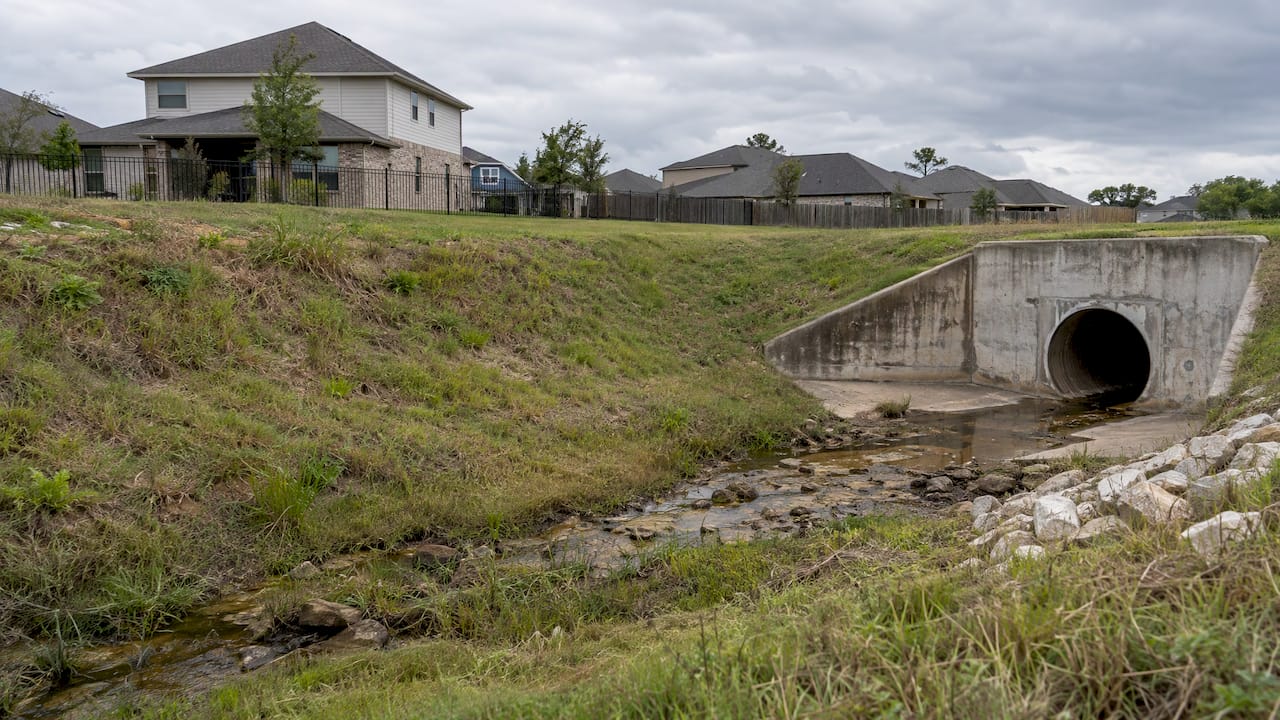
In practice, if you are shopping in the newer parts of Cedar Park, Round Rock, Georgetown, Pflugerville, Leander or the outer Travis and Hays County areas, a MUD may be part of the picture. The district is the reason a new neighborhood has pipes and drainage in the ground. The tax is how the people who live there repay it.
Is a MUD tax separate from your property tax?
It is part of your property taxes in the sense that it is a tax on your real property, but it is its own line, set by its own board. Anthem MUD, in Hays County, says its property tax is separate from county property taxes and is collected by a different tax office. That means the MUD bill can arrive separately from your county bill, and a lender’s escrow account has to account for it.
TCEQ explains why the tax exists in the first place. When voters authorize tax-backed bonds, the district board must levy an annual property tax large enough to cover the outstanding debt. The tax applies to taxable property in the district based on its appraised value, regardless of which services an individual owner actually uses. So two neighbors with the same appraised value pay the same MUD tax, whatever their water use.
If you are building a full monthly budget, our guide to Austin-area property taxes by city shows how the other layers stack up, and the Austin-area property tax office guide explains which office answers which question.
How much a MUD tax costs: the formula and a worked example
Rates change every year, so I do not give you one number for “the” Austin MUD tax. Each district sets its own, and the board publishes a notice of the rate before it sets or changes it, according to TCEQ. The formula, though, is the same everywhere.
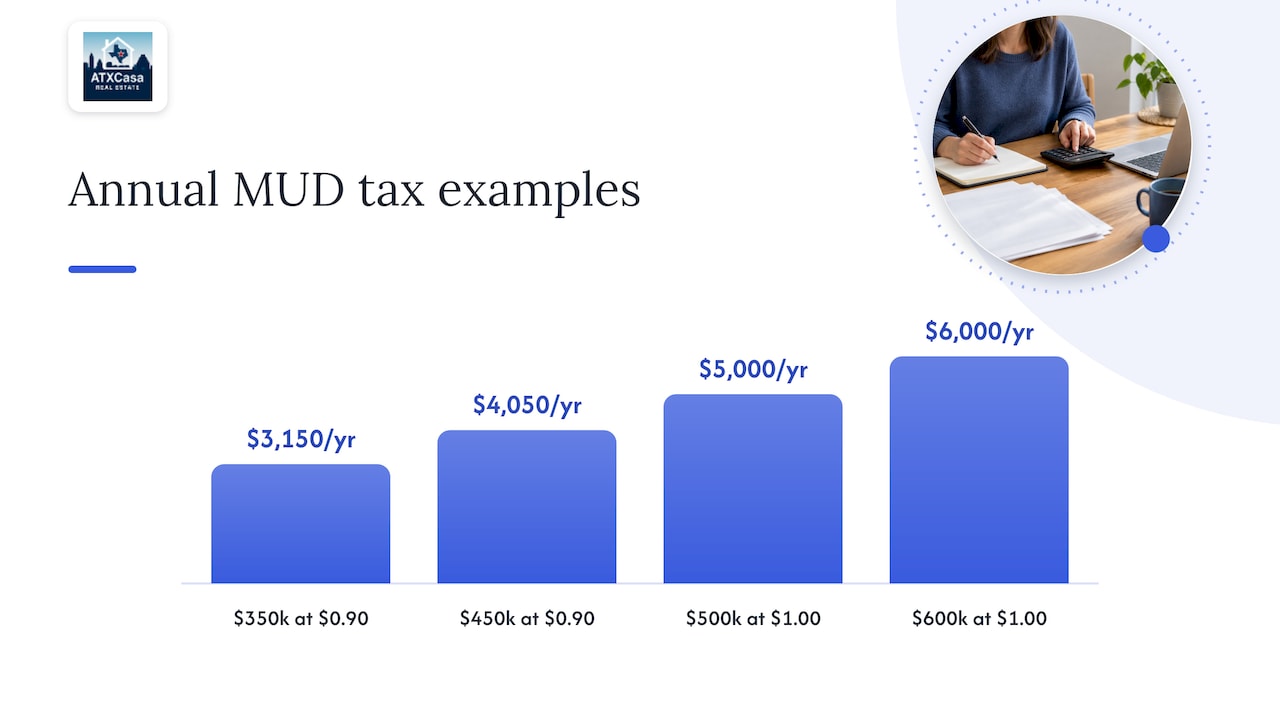
Anthem MUD’s 2025 FAQ gives it plainly: divide the assessed home value by 100, then multiply by the district’s tax rate. Its example is a $500,000 value at a rate of $1.00 per $100, which produces $5,000 a year.
Here is how that looks for a few values at the same rate. This is an illustration of the arithmetic, not a quote for any district.
| Assessed value | Rate per $100 | Annual MUD tax | Per month |
|---|---|---|---|
| $350,000 | $0.90 | $3,150 | $262.50 |
| $450,000 | $0.90 | $4,050 | $337.50 |
| $500,000 | $1.00 | $5,000 | $416.67 |
| $600,000 | $1.00 | $6,000 | $500.00 |
A few things move that result in a real purchase:
- The appraised value, not your purchase price, is the base. The county appraisal district sets it. A new build can be appraised on land only until the home is finished, so the first bill may understate later ones. Our new-build tax escrow check walks through how to estimate this before closing.
- The rate has two parts. TCEQ says a district may also seek voter authorization for a maintenance tax to pay operating and maintenance costs, and it cannot exceed the voter-authorized maintenance rate without another vote. The Ranch at Cypress Creek MUD FAQ explains that its debt-service tax is restricted to bond debt, while its maintenance-and-operations tax pays for other allowed district expenses. Look at that split, not only the total.
- Utility fees are separate. The City of Austin guide says districts repay debt with property-tax revenue and utility-user fees. The tax bill is one cost, and the water and sewer bill is another.
My read: when two homes look similar on price, a difference of even $0.20 per $100 on a $450,000 value is $900 a year. That is more than $75 a month, which is enough to change what a lender will approve.
How MUD taxes are paid and when they are due
The district names its tax collector, and that is where you pay. Anthem MUD’s FAQ says payment goes through its listed collector and is due by January 31 to avoid penalties and interest starting February 1. Other districts follow a similar yearly cycle, but confirm with your own district.
If you have a mortgage, the lender usually collects the tax monthly in escrow and pays it for you. The catch is that your lender needs the right MUD tax in its estimate. If the first-year estimate is built from a land-only value or an old rate, the escrow shortage shows up later as a higher payment. That is one reason I ask for the district’s current rate in writing at the start of a home search.
How long a MUD tax lasts
There is no fixed number of years. The tax lasts as long as the district has to repay debt. TCEQ says the board must levy annual taxes sufficient to cover the outstanding tax-backed debt, and voter-approved maintenance taxes can continue to pay operating and maintenance costs.
Two things shape how long it runs:
- Bond maturity and new bonds. A district that issues more bonds as the community builds out extends its debt. Ask for the debt schedule, not only the current rate.
- Annexation. The City of Austin guide says that if Austin annexes a MUD before the bonds are fully paid, the city assumes the remaining MUD debt. State law lets it use surcharges on former MUD residents’ utility bills afterward. So annexation can change how you pay, without necessarily erasing the cost.
As a district matures, the rate often becomes more predictable. The Texas Municipal League’s MUD white paper says early-stage MUDs have an 8% voter-approval tax rate, which drops to 3.5% once a district meets its developed-district criteria. In plain terms, that is how much a district can raise its tax revenue before voters get a say, and it is lower for mature districts.
What changed recently in Texas
The Texas Comptroller’s 2025 property tax law summary lists three changes that touch districts like MUDs:
- HB 103, effective September 1, 2025, requires public reporting of bond and tax information in a database that includes water districts.
- SB 1023, effective January 1, 2026, requires tax-rate calculation forms to include hyperlinks.
- SB 1025, effective May 24, 2025, adds the words “THIS IS A TAX INCREASE” to tax-increase ballot propositions.
These are transparency and election rules. They do not cap MUD rates. For a buyer, the useful part is HB 103: searchable bond, tax, project and debt-service records make it easier to look at a district’s borrowing beyond the headline annual rate.
How to check a home before you make an offer
This is the routine I use with buyers. It takes about an hour and it can change the numbers you plan around.
- Find out which taxing units apply. Search the address on the county appraisal district’s property database (Travis, Williamson, Hays or Bastrop, depending on the location). It lists the taxing units on the property, and whether a MUD is among them.
- Get the district’s rate in two parts. Visit the district’s own website or call its office. Write down the debt-service rate, the maintenance rate and the total, plus the year they apply to.
- Request the debt picture. TCEQ says the purchaser notice can include the district’s current tax rate and bond information, and that districts file information and maps with the county clerk. Ask how much debt is outstanding and whether more bonds are authorized.
- Read the seller’s notice. Texas Water Code Section 49.452 requires the seller of property in a covered district to give the purchaser written notice before a binding contract. If the seller omits it, the buyer may terminate unless the notice is supplied by closing and the buyer chooses to close. The buyer signs to acknowledge receipt, and at closing the parties sign a separate notice with current information, which is recorded in the county deed records. Coverage has exceptions, so the title company and your agent should confirm how it applies to your sale.
- Run the monthly budget. Add the MUD tax to the county, school and any city or other district tax, then add insurance and utilities. Compare the whole figure across the homes you are considering.
- Confirm escrow with your lender. Give them the MUD rate and the appraised value so the first-year estimate is not understated.
For a new build, repeat step 5 using the future appraised value, not the land-only value on the first bill.
What this means for each type of reader
First-time buyers. A MUD can be a fair trade: newer construction with a higher total tax rate and sometimes a lower price. Judge it by the monthly total, not the price.
Families relocating. If you are moving from another state, the layered tax bill can be unfamiliar. Our California to Austin homebuying guide and the Austin cost of living breakdown put the taxes and utility charges next to rent and other costs.
Investors. The tax is a line in your operating expenses. A higher MUD rate lowers net rent, so model it with the district’s real debt-service and maintenance split.
Sellers. If your home is in a MUD, expect buyers to ask about the rate. Having the district’s current figures and the notice ready makes the sale cleaner and keeps the conversation on the home.
Our perspective
We build every Austin-area search around the total monthly cost of owning the home, because that is the number a family lives with. A MUD tax is one of the largest items inside it for newer neighborhoods, and it is easy to miss when you are comparing listing prices.
The way we work reflects our background: nearly two decades of IT experience means we like data. We compare the debt-service and maintenance rates, the appraised value and the tax history for the address, so the price you offer reflects what you will actually pay each year.
Our advice is simple. Do not stop at the total rate. Look at what the district owes, what it can still borrow, and how your escrow is estimated. With those numbers in hand, a MUD home can be a confident decision rather than a surprise.
Vladimir
Get the full tax picture for an address
We help buyers, sellers and investors across the Austin area, including Cedar Park, Round Rock and Georgetown, with AI-powered, data-driven pricing and personalized guidance that covers everything from neighborhood trends to hidden home pitfalls. If a home you like sits in a MUD, we will go through the tax rate, the debt and the monthly cost with you before you make an offer.

Start at ATXCasa, or browse our Austin real estate guides and market updates while you compare neighborhoods.
FAQ
How much is MUD tax in Texas?
It depends on the district and your home’s appraised value. The formula is the value divided by 100, times the district’s rate. Anthem MUD’s example is $5,000 a year on a $500,000 value at $1.00 per $100. Get the current rate from your district’s website or tax collector.
Is MUD tax separate from property tax in Texas?
It is a property tax, but it is levied by the district, not the county or school district. Anthem MUD says its tax is separate from the county’s and collected by a different tax office. Your lender should include it in escrow as its own item.
How long does a MUD tax last?
As long as the district has tax-backed debt to repay, according to TCEQ, and a voter-approved maintenance tax can continue for operating costs. If the City of Austin annexes a district, it assumes the remaining debt, and it may add surcharges to former MUD residents’ utility bills.
How are MUD taxes paid, and when are they due?
You pay the district’s named tax collector, or your lender pays from escrow. Anthem MUD says its tax is due by January 31, with penalties and interest starting February 1. Confirm the schedule with your own district.
Sources
- Texas Water Districts: A General Guide (TCEQ)
- Municipal Utility District (MUD) Basics (City of Austin)
- Anthem MUD Frequently Asked Questions on MUD Tax
- FAQ, Ranch at Cypress Creek MUD
- Property Tax Law Changes 2025 (Texas Comptroller)
- TML MUD White Paper
- Texas Water Code Section 49.452