

If you are preparing to buy a home in Austin, start discussing preapproval before you tour seriously. Each lender sets its own process and documentation requirements, so ask what it will review and when it expects to issue a letter. The Consumer Financial Protection Bureau (CFPB) describes letter expiration dates as typically 30 to 60 days; confirm your lender’s deadline. Preparing your paperwork helps you respond promptly, but it does not put the lender’s review schedule in your hands.
TL;DR
- Ask each lender for its expected preapproval turnaround and the documents it needs. Review depth and documentation requirements differ by lender.
- Missing documents, self-employment income and recent credit changes cause most delays, so gather paperwork first.
- The CFPB describes preapproval expiration dates as typically 30 to 60 days. Confirm the expiration date on your letter and ask what your lender requires to renew it if you are still shopping.
- A preapproval is a tentative commitment, not final loan approval. Use it to set your search budget, then keep your finances steady until closing.
- Start two to four weeks before your first showing, so a letter is ready when the right Austin home appears.
Table of Contents
- How long preapproval takes in Austin
- What preapproval actually is
- The preparation that sets your timeline
- What slows preapproval down
- How long a preapproval letter lasts
- Shop more than one lender, on a schedule
- A realistic Austin timeline, week by week
- Perspective
- Where we fit in your timeline
- FAQ
- Sources
How long preapproval takes in Austin
For an Austin home search, ask each lender for its expected preapproval turnaround. The CFPB explains that every lender is different: some base a letter on information you provide, while others review supporting details earlier. Ask which documents the lender needs and what it will verify before issuing your letter.
Nationally, the range is wider. One large lender’s guidance says a preapproval can take a couple of days to a couple of weeks and suggests budgeting about 10 business days when your financial information needs additional verification.
Here is how I would read those two figures together:
| Your situation | Realistic planning window |
|---|---|
| Salaried, documents ready, clean credit file | Same day to 3 business days |
| Some documents missing or a few questions from the lender | 3 to 7 business days |
| Self-employed, several income sources, or a recent credit event | Up to about 10 business days, sometimes longer |
These are planning windows built from the sources above, not promises. Each lender sets its own pace, and the Consumer Financial Protection Bureau (CFPB) notes that lenders ask for different levels of information and documentation. Some base a letter only on what you tell them, while others review the details with you.
Why the same-day letter is possible
Lenders request different levels of information and documentation. Some base a letter on what you tell them; others conduct a more detailed review of your information early in the process. Identifying a missing document at that stage can help prevent delays and surprises later. Ask what has been reviewed and what still needs confirmation.
What preapproval actually is
A preapproval is a lender’s tentative willingness to lend up to a stated amount, based on assumptions and subject to further confirmation. The CFPB is clear that it is not final loan approval and not a guaranteed offer. Further confirmation is still needed before the lender commits to the loan.
That matters for timing because there are two clocks. The first is the preapproval clock, which this article covers. The second starts when your offer is accepted and runs through underwriting to closing. Buyers who treat the letter as the finish line often get surprised by the second clock.
If you are unsure whether you need a full preapproval or a lighter prequalification first, our comparison of the 30 to 90 day window for prequalifying versus preapproving walks through the difference for Austin buyers.
The preparation that sets your timeline
Providing requested information promptly can reduce avoidable follow-up, but each lender sets its own process and documentation requirements. The FDIC says that gathering identification, income, tax, asset and credit information before you apply gives the lender what it needs to evaluate the loan and can save time later.
Lenders typically ask for:
- Government-issued identification
- Pay stubs covering the last 60 days
- Two years of federal tax returns, plus W-2s
- Bank statements and investment account statements
- A list of your monthly debts (the lender pulls your credit report itself)
Depending on your circumstances, Fannie Mae lists other documents that may come up, such as divorce papers, gift letters for down payment funds and proof of past rental payments. Self-employed borrowers should also expect to provide business tax returns and a year-to-date profit and loss statement.
The CFPB has a page on how to create a loan application packet. Identifying and providing an additional document early can help prevent delays and surprises later. I would keep the lender’s requested documents in one folder, digital or paper, and update it whenever a new pay stub or statement arrives.
A simple preparation schedule
- Four weeks before your first showing: pull your credit reports and look for errors or unexpected accounts. Many conventional loans expect a score of around 620 or higher, so if yours is close to that line, you want time to fix issues.
- Three weeks before: gather the documents listed above and decide how much cash you can put down.
- Two weeks before: talk with more than one lender and submit your complete application, ideally in the morning.
- One week before: have the letter in hand and use the approved amount to set your search range, not just your ceiling.
What slows preapproval down
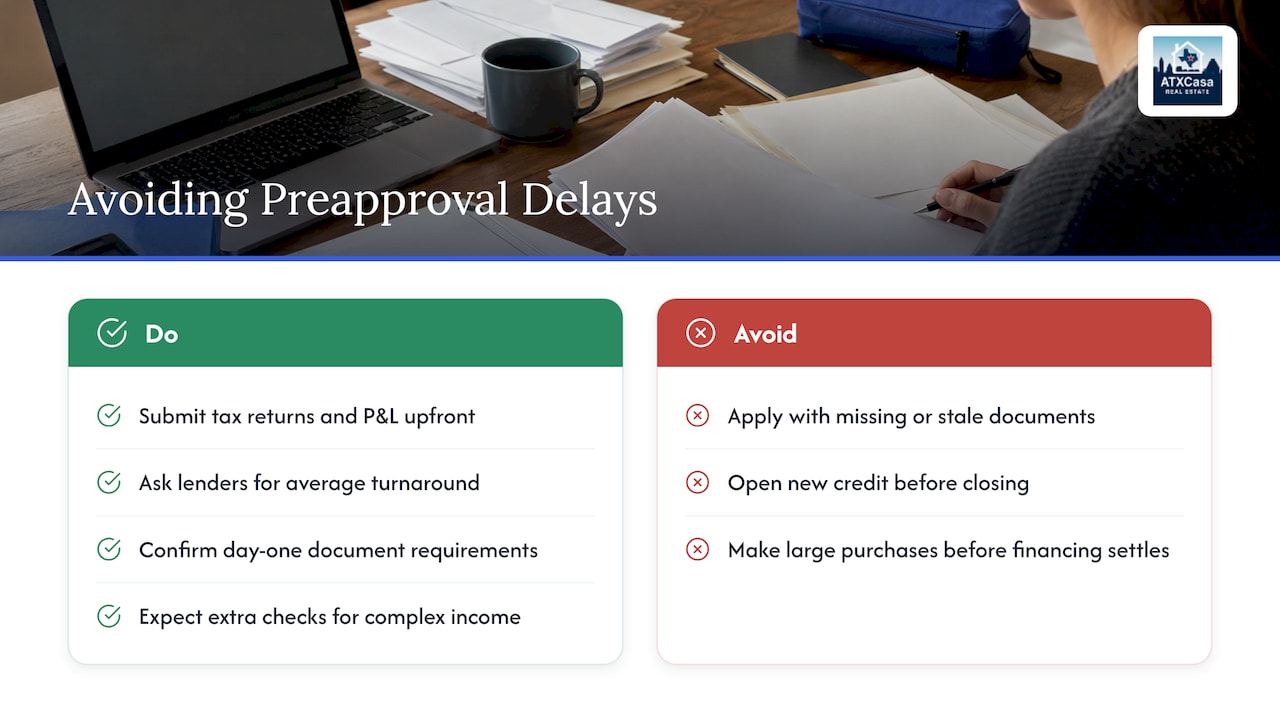
The most common cause of delay is documentation readiness. Local lender guidance names missing documents, complex income, recent credit events and incomplete applications as the main culprits. Here is how each plays out for Austin buyers.
Missing or stale documents. A pay stub that is more than 60 days old, a bank statement with a page missing, or a W-2 from the wrong year can stall a file for days while you request replacements.
Complex income. Many Austin buyers work in tech, in contract roles, or for themselves. Commission, bonus, stock compensation and self-employment income all take longer to verify than a flat salary. If this is you, submit tax returns and profit and loss statements with your first application and expect the longer end of the range.
Recent credit events. A new credit card, a car loan or a closed account in the weeks before you apply can change your debt-to-income ratio, which is your monthly debt payments compared with your monthly income. Hold off on new credit until after closing. The same goes for large purchases, and that includes planning a major home project such as a roof replacement in Texas, which is better scheduled once your financing is settled.
Heavy volume. In busy markets, application volume can slow a lender’s processing. The practical fix is simple: ask each lender for its average turnaround time before you apply. Ask whether it uses automated underwriting or manual review, and which documents it wants on day one.
How long a preapproval letter lasts
The CFPB describes preapproval expiration dates as typically 30 to 60 days. Check your letter’s expiration date and confirm the lender’s requirements if you are still shopping as that date approaches. Ask what information the lender needs to renew your letter.
Two practical points follow from that window:
- Do not apply too early. Because letters typically expire after 30 to 60 days, many buyers wait until they are ready to shop seriously. An earlier preapproval can still be useful if it identifies issues you need to address before buying.
- Do not apply too late. If you wait until you have found a home, you may lose a few days that matter. In Austin’s more affordable price ranges, well-priced homes can draw multiple offers within days, and a seller will often prefer the offer that arrives with a letter attached.
Hard credit inquiries can affect your score; soft inquiries, including checking your own credit report, do not. For mortgage shopping, the CFPB says obtaining three preapprovals within a short time should have no major credit-score impact. Ask each lender whether its preapproval process involves a hard inquiry so you can coordinate your applications.
Shop more than one lender, on a schedule
The CFPB recommends asking at least three lenders for preapproval to compare likely loans and prices without committing to a lender. A reusable document folder can help you prepare, but lenders may request different information. Confirm each lender’s requirements and expected turnaround.
Preapproval letters alone are not enough to choose the best deal. After submitting official applications, ask lenders for written loan offers using the same loan type, program and term. Compare the interest rate, monthly payment, fees and other terms on that matching basis. For a deeper look at comparing quotes, see our guide on mortgage rate headlines versus your own quote.
If you plan to use down payment assistance, confirm early that your lender participates in the program. Lender rules can change the timeline, and our guide on checking down payment assistance lender rules explains what to confirm first.
A realistic Austin timeline, week by week
Here is a timeline I would build for a buyer who wants to be ready to make an offer within a month:
| Week | What you do | What you have at the end |
|---|---|---|
| 1 | Check credit reports, gather documents, set a budget | A complete document folder |
| 2 | Submit applications to several lenders | Applications in progress, questions answered |
| 3 | Receive letters, compare, choose a lender | A preapproval letter in hand |
| 4 | Start touring, set neighborhood priorities | A search range based on a monthly payment you are comfortable with |
If your income is complex, add a week or two to the front of this schedule. A letter in week two is a good outcome. A letter in week four is still fine if you are not yet competing for a specific house.
Perspective
My read: preparing your documents is a useful step you can control. It lets you respond promptly when a lender requests information, while the lender’s process and documentation requirements also affect timing. Before planning around a letter, ask what has been reviewed, what is outstanding and when the lender expects to finish.
We build our guides from the questions Austin buyers actually ask, and the same pattern comes up. Buyers who treat the letter as a research tool, not a formality, make better decisions. The approved amount is a ceiling. The monthly payment you are comfortable with is the number that should guide your search across Cedar Park, Round Rock, Georgetown and Austin itself.
How I would use this: get your documents ready first, apply early in the day, and bring the letter to your first conversation about neighborhoods. With nearly two decades in IT behind me, I look at this as a data problem. Your income, debts and savings define a price range, and local market data tells you what that range buys in each area, including property taxes and hidden home pitfalls that affect your real monthly cost.
Vladimir
Where we fit in your timeline
Preapproval answers how much a lender will lend. It does not tell you what that amount buys in Cedar Park versus Round Rock, which neighborhoods fit your commute, or what the true monthly cost looks like after Texas property taxes. That is the part we help with: personalized guidance on neighborhood trends and the pitfalls that can hide in a home, supported by data-driven pricing and local market insight from our Austin-area guides.

When your letter is ready, or while you are waiting for it, start with our Austin real estate guides and market updates or browse the buying, selling and financing library. If you are ready to talk through a purchase, an investment or a sale in the Austin area, you can reach us through ATXCasa.
FAQ
How many days does it take to get preapproved?
There is no universal preapproval turnaround. Lenders differ in the review and documentation they require, so ask yours for an estimated turnaround. Confirm which items are outstanding and when the lender expects to issue your letter.
What documents do I need for preapproval?
Plan on identification, 60 days of pay stubs, W-2s, two years of federal tax returns and recent bank and investment statements, as the FDIC outlines. Self-employed buyers should add business tax returns and a year-to-date profit and loss statement. Gift letters and rental history may also be requested.
How long is a preapproval letter good for?
The CFPB describes preapproval expiration dates as typically 30 to 60 days. Check the date on your letter and ask your lender what it requires if you are still shopping when the letter expires. Confirm any updated-document requirements rather than assuming renewal is automatic.
Does preapproval guarantee I will get the loan?
No. The CFPB describes it as a tentative commitment up to a stated amount, subject to further confirmation. Avoid new debt, large purchases and job changes until closing so the final approval matches the letter.
Sources
- How Long Does Mortgage Pre-Approval Take? Austin TX
- How Long Does a Preapproval for a Mortgage Take?
- How Long Does It Take to Get Mortgage Preapproval?
- Applying for Your First Mortgage Loan, FDIC
- Documents you need to apply for a mortgage, Fannie Mae
- Get a preapproval letter, CFPB
- Create a loan application packet, CFPB
- Shopping for a Mortgage, CFPB
- Roof Replacement in Texas: Cost, Timing and Hiring Guide