

Most Austin property managers charge a monthly fee of 8% to 10% of the rent collected, and some charge a flat dollar amount instead. The monthly fee is only part of the bill. Leasing fees, renewal fees, maintenance markups and inspection charges can push the real annual cost to 18% to 25% of gross rent. I will walk through each line item, run the numbers on a typical Austin rental, and list what to check in a contract before you sign.
TL;DR
- The headline monthly fee in Austin usually runs 8% to 10% of collected rent, while flat-fee models charge a set dollar amount per month regardless of rent.
- Tenant placement fees (50% to 100% of one month’s rent) and renewal fees ($150 to $500) are charged on top of the monthly fee at many firms.
- Compare the effective annual cost, not the headline percentage. On a $2,200 rental, a 10% fee is $220 a month, but the all-in cost often lands at $400 to $550 a month.
- Read the contract for repair approval limits, maintenance markups, vacancy charges and termination terms before you sign.
Table of Contents
- What Austin property managers charge each month
- The fees on top of the monthly fee
- A worked example: a $2,200 Austin rental
- Is hiring a manager worth it?
- Check this before you sign a management agreement
- Our perspective on management costs
- Talk to us before you commit to a plan
- FAQ
- Sources
What Austin property managers charge each month
There are two pricing structures in this market, and they behave differently as your rent changes.
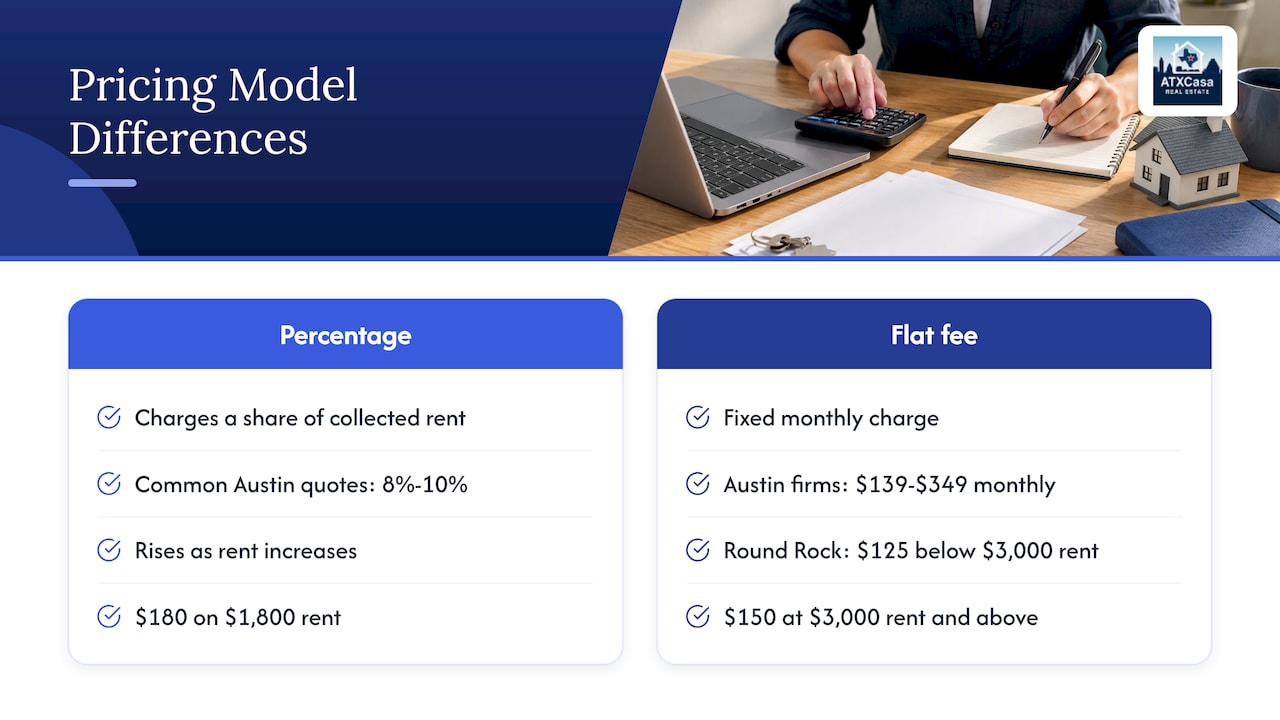
Percentage of rent. The manager takes a share of the rent actually collected. Austin quotes mostly sit between 8% and 10%, and some published guides report a wider band of 8% to 15% depending on the firm, the property type and the size of your portfolio. A lower percentage is common when you hand over several units.
Flat monthly fee. The manager charges a fixed amount. Some Austin firms publish flat-fee management at $139 to $349 a month on annual billing, and a Round Rock firm lists $125 a month for homes renting under $3,000 and $150 a month at $3,000 and above, with a tenant placement fee of 70% of one month’s rent. Software-led platforms go lower still: one national platform lists tiers from $0 a month for software only up to $86 a month for a plan with management assistance, which is a different level of service from hands-on local management.
The practical difference: a percentage fee rises with rent, a flat fee does not. On a $1,800 rental, 10% is $180. On a $3,500 rental, 10% is $350. If a flat fee covers the same services, the gap widens as rent climbs.
How the fee is calculated
The base matters as much as the rate. Ask whether the percentage applies to rent collected or rent billed. A collected-rent fee may be charged when late rent arrives. Ask when a late payment counts as collected and whether minimum, vacancy or other charges apply while rent is unpaid. Also ask whether the percentage applies to other tenant payments, such as late fees, pet rent or application fees. Some contracts take a cut of those too.
What the monthly fee normally includes
A full-service monthly fee usually covers rent collection, tenant communication, coordinating repairs, and basic accounting statements. Firms in the area describe their service as marketing, tenant screening, leasing, rent collection, maintenance coordination, inspections and financial reporting, but which of those sit inside the monthly fee and which are billed separately is the contract’s call, not an industry rule. That is where costs diverge.
The fees on top of the monthly fee
These are the charges that turn a 10% quote into something larger. Not every firm charges all of them, so request the full fee schedule in writing.
| Fee | Typical Austin range | When it applies |
|---|---|---|
| Monthly management | 8% to 10% of rent, or a flat amount | Every month rent is collected |
| Tenant placement (leasing) | 50% to 100% of one month’s rent | Each time a new tenant is placed |
| Lease renewal | $150 to $500 | Each renewal |
| Maintenance markup | Varies; some firms charge none | On repair invoices |
| Inspections, setup, vacancy | Varies by contract | As listed in the agreement |
Tenant placement fees
The placement fee pays for photos, listing syndication, showings, screening and lease signing. On a $2,200 rent, 50% is $1,100, 70% is $1,540 and 100% is $2,200. Placement is a separate cost each time you bring in a new tenant. For comparison, assuming all rent is collected for 12 months, a 10% management fee totals $2,640 over that year. One placement during that same year would add $1,100 to $2,200 under these assumptions. Compare quotes over the same period, with the same number of placements and renewals; less frequent turnover reduces how often you pay for placement.
Renewal fees
When a tenant stays, many firms charge a renewal fee for market-rent review and lease paperwork. At $150 to $500 it is far smaller than a new placement fee, and it is usually cheaper than a vacancy. If you want to understand how the tenant sees that decision, my piece on Austin rent renewal options shows the benchmark a renter compares your renewal rate against.
Maintenance markups
Some managers add a percentage on top of vendor invoices. Others bill repairs at actual vendor cost, and at least one Austin-area firm states a 0% maintenance markup policy. A 10% markup on a $1,500 air conditioning repair is $150, so ask for the policy in writing. Repair quality matters too. For routine plumbing, plumbing repair and maintenance services are a good example of the scope a coordinator may need to schedule on your behalf, from leaks to water heaters.
A worked example: a $2,200 Austin rental
Here is the arithmetic on a house renting for $2,200 a month ($26,400 a year). The percentage ranges come from the Austin figures above.
| Monthly fee rate | Per month | Per year |
|---|---|---|
| 8% | $176 | $2,112 |
| 10% | $220 | $2,640 |
| 12% | $264 | $3,168 |
That is the headline cost. One published Austin analysis estimates that after leasing, maintenance, inspection and renewal charges, the true cost often lands at $400 to $550 a month, or 18% to 25% of rent. On $26,400 of annual rent, 18% is $4,752 and 25% is $6,600. Treat this as a planning range, not a quote: your number depends on turnover, repair volume and the contract.
A flat-fee comparison: at a $3,000 rent, a 10% fee is $300 a month, while a $150 flat fee is half of that. Over a year, that is $1,800 versus $3,600 before any leasing or renewal charges. The flat model is cheaper only if the service scope matches, so compare what is included, not only the price.
How I would use this. Build a simple spreadsheet with three columns: monthly fee, expected fees per year (one placement every two years, one renewal in between, an average repair bill), and total. Run it for each quote. The lowest headline rate is often not the lowest annual cost.
Is hiring a manager worth it?
The answer depends on your time, distance and the property’s risk, not on a universal formula.
- Vendor pricing. Property managers argue that owners who self-manage call vendors as one-off customers and pay more for the same work, which is part of what a manager’s fee covers. Treat that as a manager’s claim and test it by asking for sample invoices.
- Vacancy. A manager who fills the home two weeks faster can recover a good part of the fee. On a $2,200 rent, two weeks of vacancy is roughly $1,100 in lost rent.
- Quality of service. Advice for owners is to judge a manager on systems, communication and screening rather than only the lowest quoted percentage.
- Distance. If you are moving out of Austin and keeping the house, remote self-management gets harder. My rental readiness checklist for owners leaving Austin helps you decide whether to rent or sell before you price management.
The rent level you can expect also changes the math. Check current rents, vacancy and concessions in the Austin rental market report before you assume your income.
Check this before you sign a management agreement
A contract defines what you pay, so read it as a cost document. A checklist drawn from common guidance: confirm the fee basis, repair approval limits and the renewal, vacancy, setup and inspection charges, and ask for a sample contract and the maintenance and vendor procedures.
- Fee basis. Rent collected or rent billed? Does the percentage apply to late fees and pet rent?
- Placement and renewal fees. Get the exact percentage or dollar amount in writing.
- Repair spending limit. Professional agreements commonly set repair spending thresholds, scope of authority, termination procedures and reimbursement rules. Pick a threshold you are comfortable with, so you are called before large repairs.
- Maintenance markup and vendor choice. Can you use your own vendors? Is there a markup?
- Termination. Is there a cancellation fee, a notice period or a long-term commitment? Some Austin firms advertise no long-term management contracts.
- Licensing. Texas licensing requirements depend on the duties performed by people who manage rental property for others for compensation. TREC says a license is required for paid showing or leasing for an owner and for controlling acceptance or deposit of rent from a resident of a single-family residential unit. Ask for the license number and supervising broker when those activities are part of the service.
- Legal review. Have a Texas attorney review the agreement before you sign it.
Our perspective on management costs
We see the same pattern in questions from owners across Austin, Cedar Park, Round Rock and Georgetown: the owner compares percentages and misses the per-year total. Our view is that cost should be tied to the property’s numbers, and that is why we approach it with data. Vlad Baibus brings nearly two decades of IT experience to real estate, and our approach is designed to put pricing, rent and neighborhood data in front of an owner before any decision, so the management fee is judged against realistic rent and turnover rather than a rule of thumb.
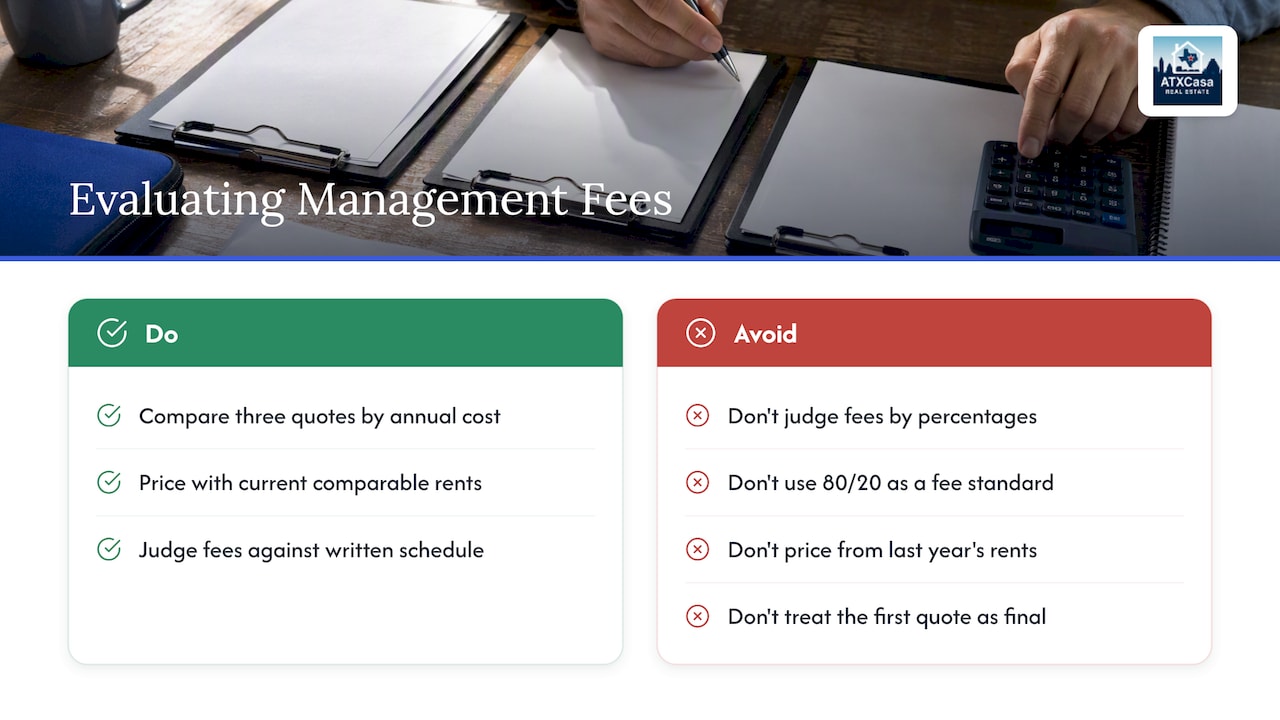
Three things we recommend. First, decide whether you should hold the property at all: renting is one path, selling is another, and the right choice depends on your equity, your mortgage rate and your local rent. Second, price the rental with current comparable rents, not last year’s. Third, treat the first management quote as a starting point and compare at least three on effective annual cost. We built our guides around the questions clients actually ask, and this is the one we hear most from owners turning a home into a rental.
On the 80/20 rule: you may see it cited in property management discussions. It is a general idea that a small share of issues, such as a few tenants or properties, creates most of the work, not a fee standard. It may help explain why some managers want a minimum per-door fee, but I would not use it to judge a quote. Judge the quote by the written fee schedule.
— Vladimir
Talk to us before you commit to a plan
If you are deciding whether to rent, sell or invest in Greater Austin, we can help you run the numbers on rent, taxes and holding costs for your address, and connect you with the right professional for your goal. Start at ATXCasa.

Before you decide, read what changes your holding costs: the 2026 Austin property tax and utility increase affects your net return as much as the management fee does. For investors, our new construction and investment articles cover the next step.
FAQ
How much does a property management company charge in Texas?
In Austin, most firms charge 8% to 10% of collected monthly rent, with some guides reporting up to 15%. Flat-fee firms charge a set amount, often in the low hundreds of dollars per month. Tenant placement fees and renewal fees usually come on top.
What does the monthly fee usually cover?
Typically rent collection, tenant communication, maintenance coordination and monthly statements. Marketing, screening, inspections and renewals may be inside the fee or billed separately, so check the fee schedule line by line.
Is a flat fee better than a percentage?
It can be cheaper on higher-rent homes, since the fee does not rise with rent. At a $3,000 rent, a $150 flat fee is half of a 10% fee. Compare service scope and the other charges before choosing.
What does the 80/20 rule mean in property management?
It is a general principle that roughly 20% of causes drive 80% of results, applied to tenants or issues. It is not an Austin fee rule, so use the written fee schedule to compare quotes.
How do I pick the best manager in Austin?
Compare effective annual cost, license and broker, repair approval limit, maintenance markup, termination terms and tenant screening process. Ask for a sample contract and for references from owners with similar properties.
Sources
- Austin property management fees (2026)
- Rent or sell my Austin home (2026)
- How much does property management cost in Austin?
- Austin and Central Texas property management, flat fee
- Austin property management fees and pricing
- Property management software pricing
- What property management actually costs in 2026
- Property management fees in Texas
- Property management agreement sample
- How to become a licensed property manager in Texas