

A rate buydown is money paid at closing to lower your mortgage interest rate. In a permanent buydown, you pay discount points to cut the rate for the life of the loan. In a temporary buydown, usually funded by a seller or builder, the payment is reduced for the first one to three years. In Austin, where seller concessions and builder incentives are common negotiating tools, knowing which type you are being offered, and what it costs, matters more than the headline rate.
I work with Austin-area buyers in Cedar Park, Round Rock, Georgetown and the city itself, and the same questions come up: who pays, what happens when the discount ends, and whether points beat a price cut. This guide answers those with worked numbers you can rerun with your own quote.
TL;DR
- A permanent buydown uses discount points (one point is 1% of the loan amount) to lower the rate for the whole loan. It pays off only if you keep the loan past the break-even point.
- A temporary buydown (1-0, 2-1, 3-2-1) lowers your payment for one to three years, then the payment rises to the full note-rate amount.
- Lenders qualify you at the full note rate on conventional loans, so a temporary buydown does not help you qualify for a larger loan.
- Seller credits can fund a buydown where loan rules allow, so compare a credit toward a buydown with a price reduction in dollars per month.
- Rates quoted online are references, not offers. Your own Loan Estimate decides.
Table of Contents
- What a rate buydown is
- Permanent buydowns: paying points
- Temporary buydowns: 1-0, 2-1 and 3-2-1
- What happens when the buydown ends
- Who pays for a buydown in Austin
- Price cut or buydown: how to compare
- Benefits and tradeoffs to plan around
- Austin rates: how to use the numbers you see
- Rate buydown checklist before you sign
- Work through your own numbers with us
- FAQ
- Sources
What a rate buydown is
Legal references define a mortgage rate buydown as an arrangement in which funds provided in connection with the loan lower the borrower’s interest rate, the monthly principal-and-interest payment, or both. Cornell Law School’s legal encyclopedia separates two forms: temporary buydowns that subsidize early payments, and permanent buydowns that use points paid at closing to reduce the contractual rate for the life of the loan.
The practical difference is simple. A permanent buydown changes your loan. A temporary buydown changes who pays part of your payment for a while. Everything else follows from that.
Permanent buydowns: paying points
One discount point equals 1% of the loan amount and counts as part of your closing costs, according to the same legal reference. A large bank’s consumer guide gives a $400,000 example: one point costs $4,000 and may lower the rate by about 0.25%, depending on the lender.
Here is a hypothetical comparison using a $400,000, 30-year fixed loan. The payments below cover principal and interest only, excluding taxes, insurance and any mortgage insurance:
| Scenario | Rate | Monthly principal and interest | Upfront cost |
|---|---|---|---|
| No points | 6.00% | about $2,398 | $0 |
| One point | 5.75% | about $2,334 | $4,000 |
| Monthly savings | about $64 |
In this hypothetical $400,000, 30-year fixed comparison, monthly principal and interest is $2,398.20 at 6.00% and $2,334.29 at 5.75%. The $4,000 point reduces the payment by $63.91 per month. Dividing the point cost by the unrounded monthly reduction gives a simple cash-flow break-even of about 62.59 months. Selling or refinancing sooner would leave the point cost unrecovered through monthly payment reductions. Keeping the same loan for 10 years produces about $7,669.28 in gross payment reductions, or $3,669.28 after subtracting the point cost. This comparison excludes time value, taxes, fees and differences in the loan balance due at sale or refinance.
When points tend to fit
- You plan to keep the home and the loan well beyond the break-even.
- You have cash beyond your down payment and reserves.
- You value a lower, fixed payment more than flexibility.
NerdWallet notes that if you want long-term rate stability and can pay upfront, discount points may be the better strategy than a temporary buydown. I agree for buyers who see this as a long-term home.
Temporary buydowns: 1-0, 2-1 and 3-2-1
A temporary buydown lowers the payment you make during the first one to three years. The lender still receives the full payment at the original rate, because a seller or other third party pays the difference. The bank guide linked above describes it as seller or third-party funded, with the buyer’s payment reduced for the first one to three years.
The names describe the step-ups:
- 1-0: the rate is 1 percentage point lower in year one, then the full rate.
- 2-1: 2 points lower in year one, 1 point lower in year two, then the full rate.
- 3-2-1: 3, 2 and 1 points lower in years one, two and three, then the full rate.
The legal reference illustrates a 3-2-1 with a 7% note rate: payments calculated at 4%, 5% and 6% in the first three years, then the full 7% payment in year four.
A worked 2-1 example
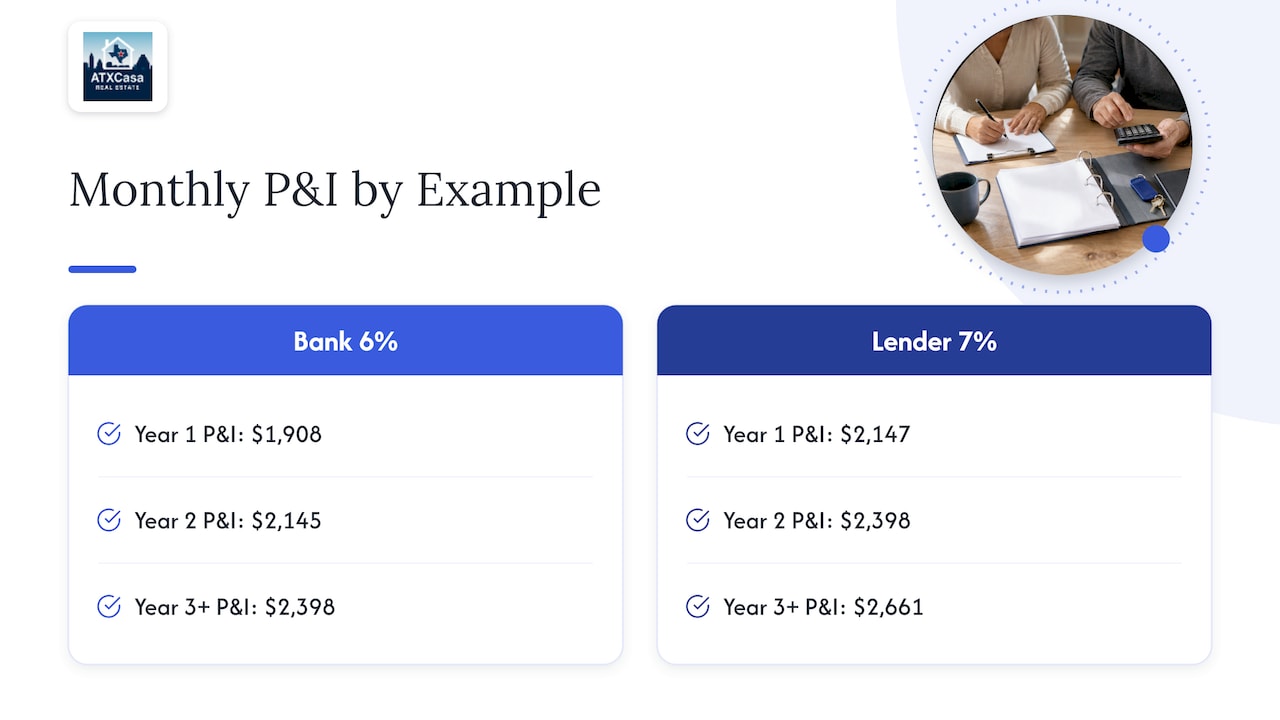
Using the bank’s $400,000 at 6% example as a starting point, a hypothetical 30-year fixed loan has borrower principal-and-interest payments of $1,909.66 in year one, calculated at 4.00%; $2,147.29 in year two, calculated at 5.00%; and $2,398.20 from year three at the 6.00% note rate. Taxes, insurance and any mortgage insurance are additional. Using unrounded payments, the total subsidy for the first two years is about $8,873.48, which is the amount needed to cover those payment differences. For the same $400,000 principal and 30-year term at a 7.00% note rate, the corresponding payments are about $2,147 in year one, $2,398 in year two and $2,661 from year three.
The money is typically placed in a separate escrow account at closing and released to the lender each month. You do not receive it as cash.
Limits on temporary buydowns
On conventional loans, published summaries of Fannie Mae’s rules say the reduction cannot exceed 3% in total, steps cannot be more than 1% per year, and the buydown period cannot run past three years. Your lender confirms what applies to your specific loan type, whether conventional, FHA or VA.
What happens when the buydown ends
The payment rises to the amount in your original note. PNC’s guidance says the rate adjusts to the higher rate in the original loan contract, and you must qualify at the full rate. For conventional loans, the lender qualifies you on the note rate, not the bought-down rate, as summarized from Fannie Mae’s guidance.
Two consequences for planning:
- A temporary buydown will not raise the price you can be approved for. It eases the first years of ownership only.
- The full note-rate payment after the subsidy ends should already fit your budget. For a 2-1, that starts in year three; for a 3-2-1, it starts in year four because year three is still subsidized. Test the full payment, including applicable taxes, insurance and mortgage insurance, against your income and other debts. Our homebuyer payment versus total debt check walks through that comparison.
If you want to see how a payment that changes over time stacks up against a fixed one, the Austin ARM versus fixed guide applies the same idea of testing the maximum payment first.
Who pays for a buydown in Austin
In practice there are three sources:
- The seller, through a concession negotiated in the contract.
- A builder, often as a standard incentive on new construction.
- You, by paying points at closing from your own funds.
Seller credits, sometimes called interested party contributions, can cover lender fees, title and escrow charges, and prepaid taxes and insurance, and can also fund a temporary buydown depending on loan rules. Limits on how much a seller can contribute depend on loan type, occupancy and down payment, so ask your lender for the cap on your specific loan before you write the offer.
Builders are where I see temporary buydowns most often. If you are weighing a new build against a resale, the comparison of builder incentives and resale homes shows how to put an incentive on the same footing as a price difference.
Price cut or buydown: how to compare
A seller who offers $24,000 in concessions gives you a choice. You can take it as a lower price, as help with closing costs, or as a buydown. The right answer depends on how long you will hold the loan and what you need most: lower cash to close, a lower first-year payment, or a lower payment for good.
A method I use with clients:
- Get written quotes for the same loan at the base rate and at the bought-down rate.
- Convert each option into a monthly payment for years one, two, three and beyond.
- Add the cash you must bring to closing for each option.
- Compare the cumulative cost at your likely holding period, say five and ten years.
A permanent buydown funded by a seller credit usually wins for long holding periods. A temporary buydown usually wins when you expect income to rise or plan to refinance if rates fall. A price cut also lowers your property tax basis and your down payment, which is worth a line in the comparison. Our guide on property tax planning and housing costs category covers related budget items.
Benefits and tradeoffs to plan around
NerdWallet lists the benefit of easing into homeownership by lowering costs in the first few years, and says to plan for the payment increase afterward. Movement Mortgage describes the best fit as a buyer who wants breathing room in the early years and expects income to grow.
That gives a clear way to match the tool to the buyer:
- First-time buyer with a growing income: a 2-1 funded by the seller can smooth the first two years, provided you could afford the full payment today.
- Family planning to stay a decade or more: permanent points, or a seller credit applied to points, usually give the most lasting value.
- Investor: conventional investment property rules are stricter on concessions, so confirm limits with your lender before building a buydown into your numbers.
- Buyer using low-down-payment financing: buydown costs sit on top of mortgage insurance and other costs. The comparison of low-down-payment loans and mortgage insurance helps you add everything up.
A balanced overview of the pros and cons is also available in this mortgage buydown pros and cons breakdown.
Austin rates: how to use the numbers you see
Rates change weekly, so treat any figure as a snapshot. As of late September 2026, one local lender’s page reported the Freddie Mac national 30-year fixed average at 7.03% and Austin-area conventional 30-year rates of roughly 6.85% to 7.15% for well-qualified borrowers, and it describes them as references, not quotes. Another Austin lender’s sample page listed a 6.75% conventional 30-year rate on September 18, 2026, again as example pricing tied to assumptions.
The spread between those sources is the point: your credit score, down payment, loan type and lender all move the number. For background, read our guide to rate headlines versus your personal quote. Request multiple Loan Estimates for the same loan scenario so you can compare the loan terms, principal-and-interest payment, estimated total monthly payment, cash to close, points, and lender charges.
Rate buydown checklist before you sign
- Ask the lender for the rate and the cost of each point, in writing.
- Calculate the simple cash-flow break-even in months: point cost divided by the monthly principal-and-interest reduction. This is not a complete economic comparison; it excludes time value, taxes, fees and differences in the loan balance due at sale or refinance.
- For a temporary buydown, write down each subsidized payment and the full note-rate payment afterward. A 1-0 reaches that full payment in year two, a 2-1 in year three, and a 3-2-1 in year four. Confirm that the full payment, including applicable taxes, insurance and mortgage insurance, fits your budget.
- Confirm in the purchase contract how the concession is written and that your lender accepts it.
- Ask whether the funds go to points, closing costs or a temporary subsidy, because they are not interchangeable.
- If you plan to use down payment assistance, check how it interacts with seller credits. Our down payment assistance and time-saved tradeoff article explains the tradeoffs.
Our perspective
We build our guidance around one habit: put every offer into monthly dollars and total dollars before reacting to a headline rate. Most of what confuses buyers about buydowns disappears once the year-one, year-three and year-ten payments are on one page.
Our approach, led by a Realtor with nearly two decades of IT experience, is data-driven. We use local market data and pricing analysis to show what a seller concession is worth in your situation, and we make the comparison between a price reduction, closing-cost help and a buydown explicit during the negotiation, not after it.
For most buyers we speak with, the question is not whether buydowns are good, but which structure matches the length of time they expect to hold the loan. We would rather you choose the structure that fits your plan and your budget than the one with the most attractive first-year payment.
Vladimir
Work through your own numbers with us
If you are buying, selling or investing in Austin, Cedar Park, Round Rock or Georgetown, we can help you model a buydown against a price reduction on the specific home you are considering, and structure the offer so the concession is written correctly into the contract. We also help sellers decide whether offering a buydown can widen their buyer pool without giving up more than a price cut would.

Start at ATXCasa and tell us which home or neighborhood you are looking at. We will go through the payment comparison with you.
FAQ
Is a rate buydown worth it?
It depends on how long you keep the loan and who pays. A permanent buydown pays off after the break-even point, which in the $400,000 example above is about five years. A temporary buydown is worth it mainly when a seller or builder funds it and you can comfortably afford the full payment later.
Can a seller pay for my rate buydown in Texas?
Yes, seller concessions can be used toward a buydown where your loan program allows it. The amount a seller may contribute depends on the loan type, occupancy and down payment. Ask your lender for the limit on your loan, then have the concession written into the contract.
What happens after a 2-1 buydown ends?
Your payment steps up to the full amount based on the note rate in your original loan. In the $400,000 at 6% example, it moves from $1,908 in year one to $2,145 in year two and $2,398 from year three. You were qualified at the full rate from the start.
Is a permanent buydown better than a temporary one?
Neither is better in every case. Points suit buyers who will hold the loan for many years and have spare cash. Temporary buydowns suit buyers who want lower early payments, often paid by a seller or builder, and expect their income to rise or plan to refinance.
Sources
- Mortgage rate buydown, Cornell Law School Legal Information Institute
- How to buy down your mortgage interest rate, Chase
- Mortgage rate buydowns explained: 2-1 and 3-2-1, JD.Mortgage
- Builder rate buydowns: how 2-1 and points are priced, Home Stimulus
- How to buy down the interest rate on a mortgage loan, PNC
- Interested party contributions, Lendfriend Mortgage
- Mortgage rate buydowns: how they help buyers afford homes, NerdWallet
- How temporary rate buydowns work, Movement Mortgage
- Current Austin mortgage rates, Mortgage Austin
- Austin mortgage rates today, Texas United Mortgage