
If you own a home in Austin and plan to buy another, the hard part is the order of operations, not either transaction on its own. In the current market you can negotiate on both sides, but you need to sequence the two deals so you are never forced to sell cheaply or buy in a hurry. This guide covers the data, the three ways to sequence the moves, how a bridge loan fits, the tax rule that affects your proceeds, and a plan you can follow.
TL;DR
- Austin currently favors buyers on negotiation, which also means sellers must price carefully. Your sale and your purchase both depend on that.
- You have three ways to sequence: sell first, buy first, or close both on the same day. Each trades certainty against cost and stress.
- A bridge loan is one tool for buying first. It adds cost and needs underwriting, so price it before you rely on it.
- A seller who qualifies may exclude up to $250,000 of gain, or up to $500,000 on a joint return. The general ownership and use tests each require 24 months during the 5 years ending on the sale. For the joint exclusion, either spouse may meet ownership, but both must meet use; a prior exclusion can limit eligibility.
- Use inspectors and title companies that are independent of your agent and lender.
Table of Contents
- What the Austin market looks like right now
- Three ways to sequence your sale and purchase
- Where a bridge loan fits
- Pricing your sale in a market with many price cuts
- Buying with leverage, without skipping diligence
- Taxes that change your numbers
- A step-by-step plan
- Our perspective
- Work with ATXCasa on both sides of your move
- FAQ
- Sources
What the Austin market looks like right now
Start with the numbers, because they decide your leverage on both ends of the move.
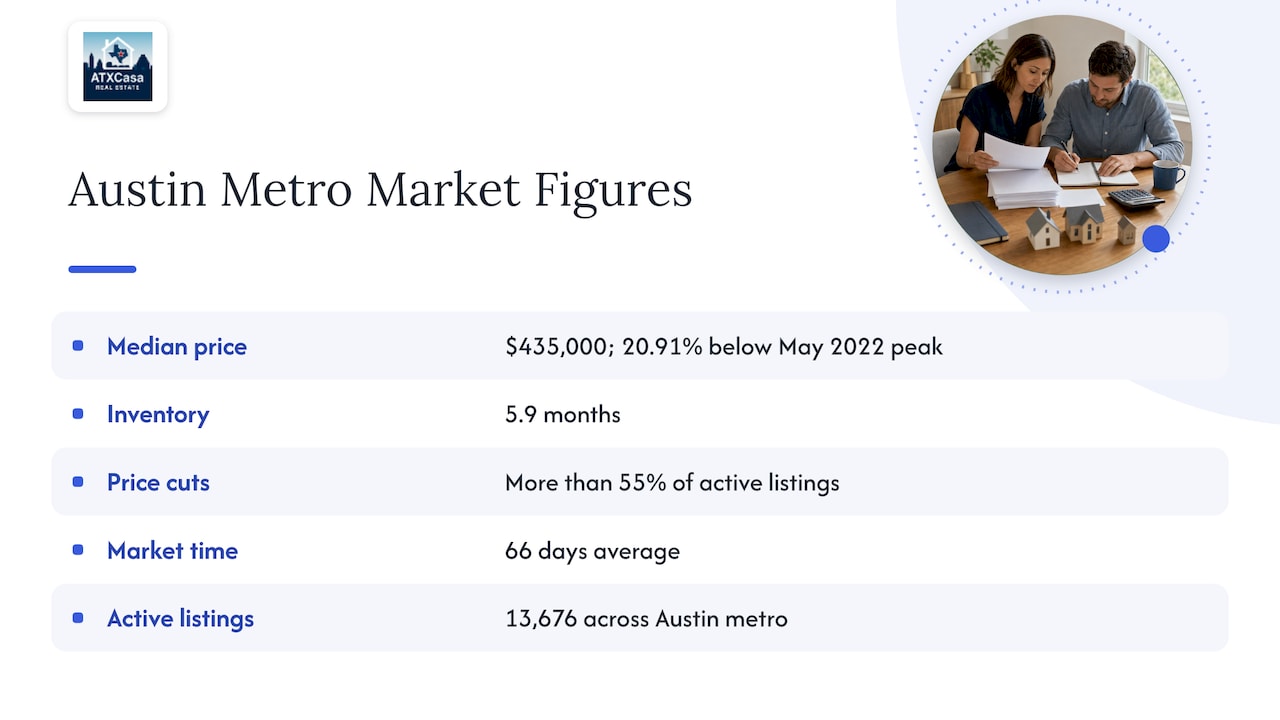
According to Mortgage Austin’s August 2026 analysis, the median sold price in the Austin metro sits at $435,000, down 20.91 percent from the May 2022 peak. The same source reports inventory of 5.9 months and price cuts on more than 55 percent of active listings.
KXAN, citing Unlock MLS data, put the average time on market for the metro at 66 days as of August 2026, with 13,676 active listings across the metro. The spread by ZIP code is wide, so the metro average tells you little about your street.
Why has the market softened? In May 2026, Texas housing economist Amy Nixon told KXAN that tech-sector over-hiring during the pandemic, followed by layoffs, created a supply and demand imbalance that continues to weigh on price growth. That report also noted a first-quarter median sales price of $415,300, down 3.4%.
What this means for a seller who is also a buyer
High inventory cuts both ways. As a buyer you have room to ask for price reductions, repairs and closing cost help. As a seller, your home competes with many others, and a listing priced on last year’s comps can sit.
My read: a move-up buyer is hurt less by a flat market than it first appears. If your sale price and your purchase price both sit below their 2022 levels, the gap between them is often smaller than the headline numbers suggest. I would still run both sides with current closed sales rather than asking prices. Our Austin housing market page tracks the local data I use for that.
Three ways to sequence your sale and purchase
There is no universally correct order. The right one depends on your equity, your income, how fast homes sell in your area and how much risk you can carry.
| Approach | How it works | Main advantage | Main risk |
|---|---|---|---|
| Sell first, then buy | List and close on your home, then shop with cash in hand | Certainty about your budget | You may need temporary housing and two moves |
| Buy first, then sell | Purchase the new home while still owning the old one | Time to choose carefully and move once | Carrying two housing payments if the sale drags |
| Same-day or coordinated closings | Negotiate both closings for the same date or close together | One move, no gap | Everything depends on both contracts lining up |
Selling first
This is the lowest-risk path financially. You know your net proceeds before you make an offer, and lenders see a clean file. The cost is flexibility: if you sell quickly and cannot find the right home, you are renting or staying with family.
In a market with ample inventory, this risk is smaller than it was in 2021. There is usually something to buy. A rent-back, where the buyer of your home lets you stay for an agreed number of days after closing, can cover a short gap. Ask for it in the offer rather than after.
Buying first
Buying first works best when you have significant equity and income that supports two payments for a few months. The lender will count both mortgages in your debt-to-income ratio unless you can document the old payment will go away. Plan for the worst case: if your home takes the 66-day metro average to sell, plus the closing period, how many months of overlap can you carry?
Another option is a purchase offer with a home sale contingency. Sellers in a softer market are more willing to consider one than in a hot market, but a contingent offer is weaker than a clean one, so expect them to prefer other terms when there are competing offers.
Coordinating closings
This can be the smoothest result and the most fragile. If you sell with a closing date and buy with a matching date, your agent and title company have to manage two contracts that can each slip. Build slack into each contract: an extension option, a short rent-back, or a few days of flexibility on possession.
Where a bridge loan fits
Readers often ask about a bridge loan in Austin, usually because they want to buy before they sell without a sale contingency. A bridge loan is short-term financing secured by your current home, meant to cover the down payment on the next one until the old one sells.
Here is what I would check before using one:
- Total cost. Bridge loans usually carry higher interest rates and fees than a standard mortgage. Ask for a written estimate of all costs for a six-month hold and a twelve-month hold.
- Qualification. Lenders generally evaluate your income against both the old and the new payments. Ask how they treat the old mortgage in your debt-to-income ratio.
- Alternatives. A home equity line of credit on your current home can serve a similar purpose, but it must usually be opened before you list the home. Ask your lender about timing.
- Exit plan. If your home sells for less than expected, what is your repayment path?
Terms vary by lender and by borrower, so get quotes from at least two lenders. I am an agent, not a lender, and I would rather you compare real loan estimates than rely on a general description. If you are still deciding whether to sell at all, our guide on whether to sell, rent or wait after buying near the peak walks through the numbers.
Pricing your sale in a market with many price cuts
When more than half of active listings carry price cuts, the first price you pick matters more than the later ones. A listing that starts high and falls in steps often sells for less than one priced correctly on day one, because buyers track listings that have lingered.
How I approach pricing:
- Pull closed sales from the last 90 days within a short distance of your home, matched on size, age, lot and condition.
- Compare the close-to-list price ratio in your neighborhood with the metro. Where homes are closing well under list, anchoring on asking prices will mislead you.
- Count competing active listings on your street or in your school zone, and note which ones have already cut.
- Decide in advance when you would reduce, and by how much, if showings are weak after two weeks.
Timing also affects the result. Our piece on when to sell your home in 2026 covers seasonality, and the seller checklist covers preparation, from repairs to photos.
Buying with leverage, without skipping diligence
The same market that makes you cautious as a seller gives you options as a buyer. Mortgage Austin notes that high inventory and widespread price cuts allow for significant negotiation, which can shorten the traditional break-even period for homeownership. That is a general statement about the market, so test it on the specific home you want.
What to negotiate
- Price relative to recent closed sales, not the list price.
- Seller-paid closing costs or an interest rate buydown.
- Repairs found during the inspection, or a credit instead.
- Possession date and a rent-back that matches your own sale.
What to verify yourself
The Texas Real Estate Commission advises using professionals such as inspectors and title companies that are not affiliated with your agent or lender, so you get a candid assessment. I agree with that, and it applies to me too: ask for independent referrals, and compare them.
For new construction or land, look past the brochure. Buildability points out that flood risk, which you can check against FEMA’s National Flood Hazard Layer, and utility readiness can cap a property’s value regardless of market trends. Check both before you commit. The Texas Attorney General’s home buying page is a good consumer-side reference on the legal documents and parties involved.
For a complete walkthrough from budget to closing, see our Austin homebuyer strategy guide.
Taxes that change your numbers
Capital gains on the home you sell
The IRS explains that a qualifying seller may exclude up to $250,000 of gain on the sale of a main home, or up to $500,000 on a joint return. Eligibility generally requires owning and using the home as a main home for at least 24 months each during the 5 years ending on the sale. For the joint exclusion, either spouse may meet the ownership test, but both must meet the use test. A seller generally cannot claim the exclusion if they excluded gain on another home sale in the prior 2 years; for the joint exclusion, this restriction applies to both spouses. Exceptions and limits can affect eligibility, so confirm your circumstances with a tax professional. Taxes for Expats gives a plain-language summary of the same rule.
Given the median price decline, many Austin sellers who bought in the last few years will have little or no gain. Those who bought a decade ago may have a larger one. A CPA should confirm your situation, especially if you rented the home out, used part of it for business, or are close to the two-year line.
Property tax on the home you buy
Property tax is a recurring cost that changes your monthly payment, so include it in your budget. The Texas Dispatch reported in July 2026 that Austin was proposing a tax rate at the legal maximum, even as the state’s larger homestead exemption appears on fall tax bills. Your actual bill depends on the taxing units where the home sits and on your exemptions.
The Austin CAD FAQ explains that appraisal districts determine appraised values and exemptions, while taxing units set budgets and tax rates. Its local guidance applies only to properties within that district’s service area; a City of Austin address alone does not establish that it serves your home. Confirm the appraisal district and taxing units for the property you plan to buy. For reporting on local protest timing, see what the Statesman noted. In most cases, the Texas Comptroller says the protest deadline is May 15 or 30 days after the appraisal district mails the notice of appraised value, whichever is later; check the notice for the applicable deadline.
A step-by-step plan
- Define your numbers. List your payoff, expected net proceeds after commission and closing costs, and the monthly payment you can carry.
- Talk to a lender early. Get preapproved for the purchase and ask how they treat the old mortgage. Request a bridge loan or HELOC quote if you are considering buying first.
- Choose your sequence. Use the table above and decide which risk you are best placed to carry.
- Price the sale from closed data. Set a price and a reduction rule before the first showing.
- Prepare the home. Do the repairs that pay back and skip the ones that do not. Our seller checklist helps.
- Shop with your terms in mind. Write offers that include the possession date and rent-back you need.
- Use independent inspectors and title. Compare at least two of each.
- Plan the move. Confirm utilities, movers and school enrollment dates around the closing dates.
- Revisit taxes. Keep your closing statements for the IRS and file your homestead exemption for the new home.
Our perspective
We built ATXCasa around a simple idea: the people selling and buying in Austin are asking practical questions, and most portals answer with promotion. Vlad Baibus spent close to two decades in IT before becoming a Realtor, and that background shapes how we work. We lean on local data, we show our math, and we use technology to give a listing wide exposure and to price it from evidence.

For a client who is doing both, we usually begin with a spreadsheet, not a showing. We model the sale price range, the net proceeds, the purchase budget and the cost of each sequencing option. Then we stress-test it: what if the home takes twice as long to sell, or the appraisal comes in low? A plan that survives those questions is one you can follow calmly.
We also tell clients when waiting is the right call. Not every move has to happen this season, and a transparent, stress-free process includes the honest answer that the numbers do not work yet.
— Vladimir
Work with ATXCasa on both sides of your move
If you are planning to sell and buy in Greater Austin, including Cedar Park, Round Rock and Georgetown, we can build the pricing model and the sequencing plan with you before you list or make an offer. Start at ATXCasa, or read our buying, selling and financing guides first.
FAQ
Should I sell my Austin home before I buy another?
Selling first gives you the most certainty about your budget and is the lowest-risk path. Buying first gives you more time to choose, but you may carry two payments. With 5.9 months of inventory reported in the Austin metro, finding a home to buy after you sell is less of a gamble than it was in tighter years.
What is a bridge loan, and is it worth it in Austin?
A bridge loan is short-term financing against your current home that helps fund the next purchase before the sale closes. It is worth considering if you have strong equity and income, and you want to avoid a sale contingency. Because rates and fees are usually higher than a standard mortgage, get written quotes from at least two lenders and compare the total cost.
Do I owe tax when I sell my house in Texas?
Texas has no state income tax, but federal capital gains rules apply. According to the IRS, you may exclude up to $250,000 of gain, or $500,000 on a joint return, if you owned and used the home as your main home for at least 2 of the last 5 years. Check with a CPA if you rented the home out or have a large gain.
Can I move out of Austin and keep my home as a rental instead?
Sometimes, but it changes your tax position and your loan terms. Our checklist on renting out your home when you move covers what to test before you decide.
Sources
- Renting vs. Buying in Austin 2026, Mortgage Austin
- Austin’s housing market: How quickly are homes selling, KXAN
- The tech market is the story, KXAN
- Buying and Selling a Home in Texas, TREC
- Buildability for Developers
- Home Buying & Moving, Texas Attorney General
- Topic no. 701, Sale of your home, IRS
- Section 121 home sale exclusion, Taxes for Expats
- Austin proposes tax rate at the legal maximum, The Texas Dispatch
- Austin CAD FAQ
- Travis County tax protest deadline, Austin American-Statesman