
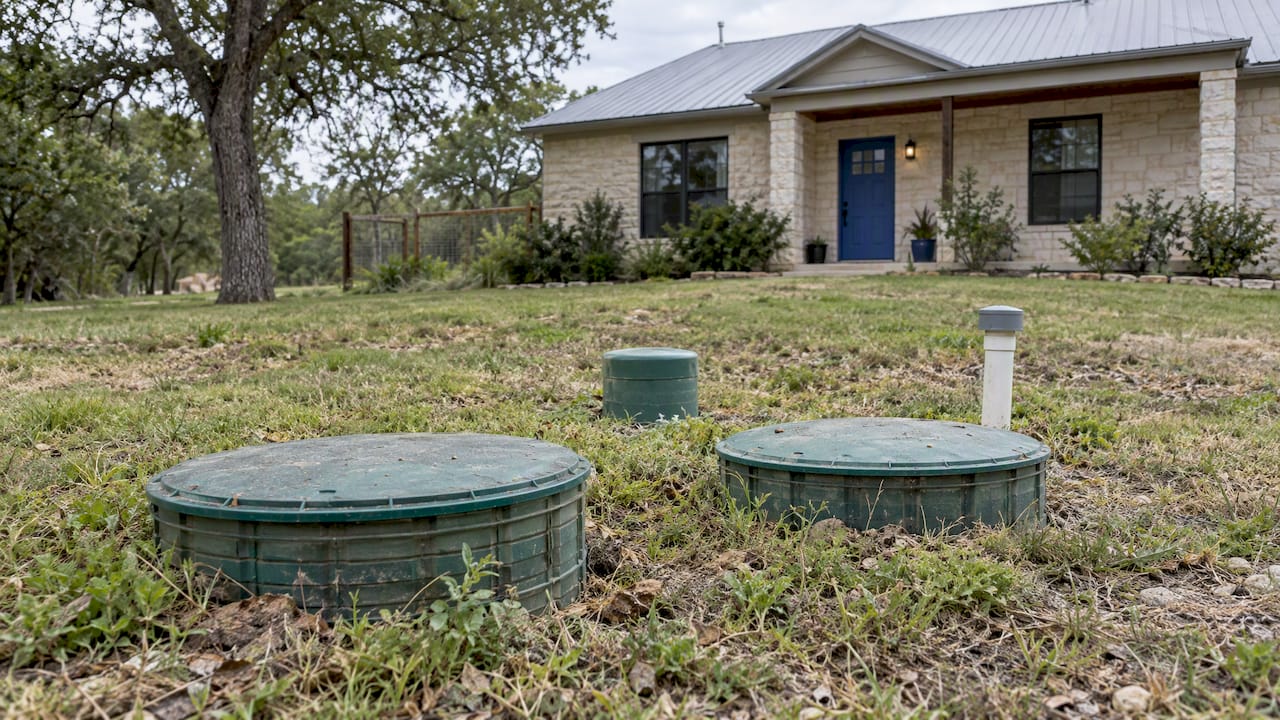
If a home is inside Austin’s city sewer service area, you pay a monthly wastewater charge and the city handles everything past your property line. If it sits on a septic system (the state calls it an on-site sewage facility, or OSSF), you own the treatment system, you pay for its maintenance, and you are responsible if it fails. Neither is automatically better. The right answer depends on the lot, the type of system, its maintenance history and what you are willing to manage. Below I cover how each works, what each costs in the Austin area, the rules that apply, and how to find out which one a property uses before your option period ends.
TL;DR
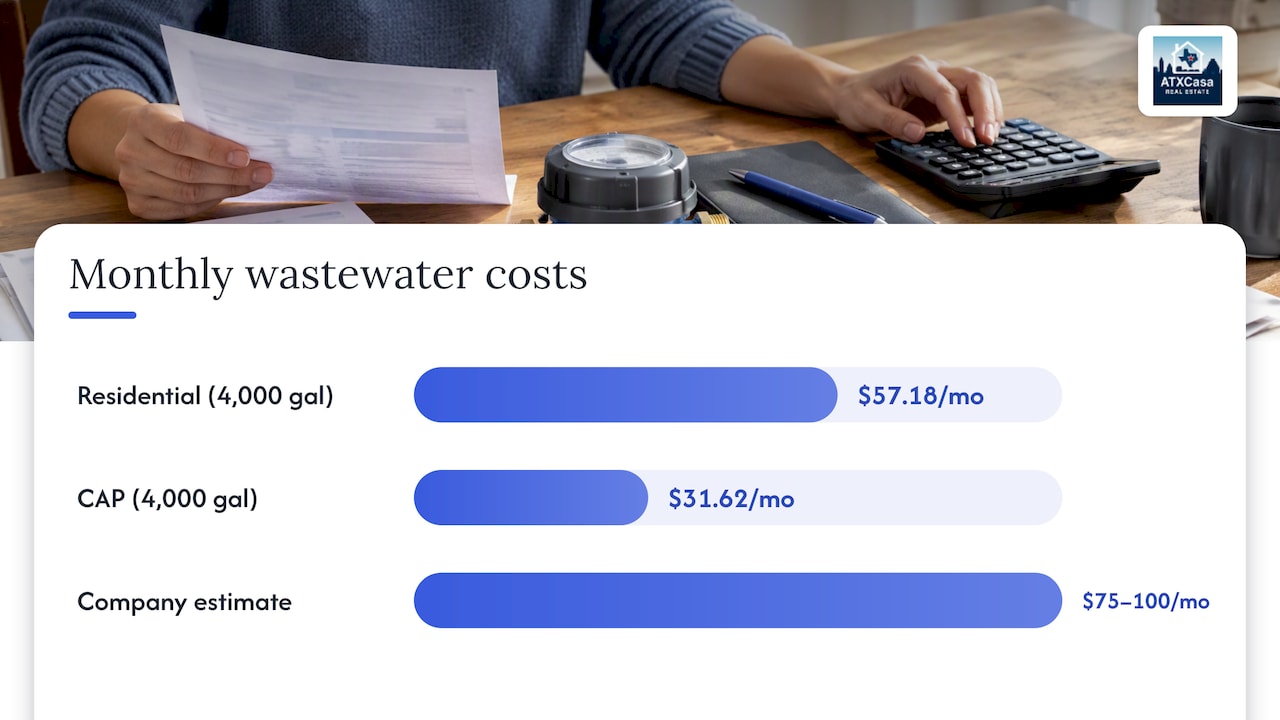
- Sewer means a monthly bill and no equipment to maintain. Austin’s FY2027 proposed budget lists a representative residential wastewater charge of $57.18 per month at 4,000 gallons.
- Septic means no monthly utility charge for wastewater, but pump-outs, inspections and, for aerobic systems, a required maintenance contract. One Central Texas septic company estimates about $3,140 over five years for a well-maintained aerobic system.
- A standard home inspection is not a septic inspection. Ask for a separate one, with a pump-out, before your option period ends. Local pricing runs from about $200 to $950 depending on scope.
- Check the permit and maintenance records. Gaps in maintenance are the most common warning sign.
Table of Contents
- How the two systems work
- Where each one is common around Austin
- What sewer costs in Austin
- What septic costs in the Austin area
- The rules that shape septic ownership
- How to find out which system a home uses
- Septic inspection: what it covers and when to order one
- Which one fits you
- Our perspective
- Getting help with an Austin purchase or sale
- FAQ
- Sources
How the two systems work
Public sewer. Wastewater leaves the house through your service line, joins a city main and travels to a treatment plant. The city owns and maintains the main and the plant. You own the line from the house to the connection point, so a root-damaged lateral can still be your bill, even though everything beyond it is not.
Septic. Wastewater flows into a tank on the property, where solids settle and are partly broken down by bacteria. The liquid then moves to a disposal area. The Texas Commission on Environmental Quality (TCEQ) states that these systems are strictly for domestic sewage, and that chemicals and solvents can kill the bacteria the process relies on and cause failure. The same page notes that a system must be designed from a site evaluation that accounts for local conditions, which matters in Central Texas, where shallow rock and clay soils are common.
Austin’s own legislative record describes an OSSF as the solution where central wastewater service is not available, and it says the owner is responsible for designing, building, operating and maintaining it under city code and Texas minimum requirements. That ownership is the real difference between the two. With sewer, you rent a service. With septic, you own the plant.
Conventional and aerobic systems
Not all septic systems behave alike. A conventional system relies on gravity and soil. An aerobic system adds an air pump and often a spray or drip disposal field, and it is common where soils cannot absorb effluent on their own. Aerobic systems have more parts that can fail. Maintenance requirements vary by local authority and system. Within Austin Water’s jurisdiction, systems classified as secondary or higher-level treatment require an initial 2-year maintenance contract; continuing requirements differ by system and use. When you tour a septic home, find out which type it has before you compare costs.
Where each one is common around Austin
Most homes inside Austin proper, and in the dense parts of Round Rock, Cedar Park and Georgetown, are on municipal sewer. Septic is concentrated in rural pockets, larger lots, parts of unincorporated Travis, Williamson and Hays counties, and some Hill Country subdivisions. A Meadows Center study summarized by the Hill Country Alliance notes that for rural communities far from central infrastructure, decentralized systems with land-based dispersal are often the most cost-effective and ecologically responsible option.
Who regulates your system depends on the address. Austin Water regulates OSSFs within the city’s full jurisdiction and in annexed areas covered under the Health and Safety Code. Outside those limits, the county handles permitting, and Travis County runs an OSSF permitting process through its development services office. A property can have an Austin mailing address and still be in the county or an extraterritorial area, so never assume the city’s utility map applies.
What sewer costs in Austin
Austin Water lists its 2026–2027 rates effective October 1, 2026. Residential customers should use the applicable water and wastewater schedule to estimate their household’s charges.
- The city’s FY2027 proposed budget gives a representative residential wastewater charge of $57.18 per month for 4,000 gallons.
- The same document gives a representative Customer Assistance Program wastewater charge of $31.62 per month at 4,000 gallons, and says the program waives the residential monthly fixed fees and discounts the volumetric rates.
The rate structure matters as much as the headline number. In the FY2025–2026 rate document, effective November 1, 2025, the residential wastewater charge was a fixed $11.26 per month plus $6.30 per 1,000 gallons for the first 2,000 gallons and $13.40 per 1,000 gallons above that. Higher winter water use therefore moves your bill more than you might expect. Use the current schedule on the city’s page for your own estimate, and remember that a representative figure is a household average, not a quote.
Some septic companies quote higher sewer budgets. One Central Texas company uses $75 to $100 per month, or $4,500 to $6,000 over five years. That range may reflect different utilities and larger households, so I would use the city’s own schedule for any home inside Austin Water’s service area.
What septic costs in the Austin area
Septic costs come in lumps rather than monthly bills. These are the figures I would plan around.
| Septic expense | Austin-area figure | Source |
|---|---|---|
| Routine pumping | $250–$700 per visit; typical Austin estimate $354–$523; $435 average | Angi, May 2026 |
| Inspection | $200–$900 | Angi, May 2026 |
| Tank cleaning | $300–$600 | Angi, May 2026 |
| Clog removal | $150–$800 | Angi, May 2026 |
| Annual maintenance | $250–$700 per year | Angi, May 2026 |
| New system installation | $8,599 average; range $4,519–$12,680 | Angi, August 2026 |
A local septic company puts a standard Austin-area pump-out at about $700 and a real estate inspection package with pumping at about $950. The difference from national-platform averages is typical: transaction-grade inspections include a full pump-out and a written report with photos, which costs more than a visual check.
Five-year comparison
The same company estimates a typical aerobic system in Central Texas costs about $3,140 over five years: roughly $1,740 in maintenance contract fees and $1,400 in pump-outs. It also says maintained septic systems run 40 to 50 percent cheaper than city sewer over that period, and that the advantage disappears if maintenance is skipped and the system fails.
Here is how I would read it. Septic can be cheaper month to month, but the risk is lumpy. A replacement at $4,519 to $12,680 erases years of savings. A buyer who prices septic honestly includes a reserve for that, plus the time cost of scheduling service. If you value a predictable bill, sewer wins on predictability even when it costs more in total.
The rules that shape septic ownership
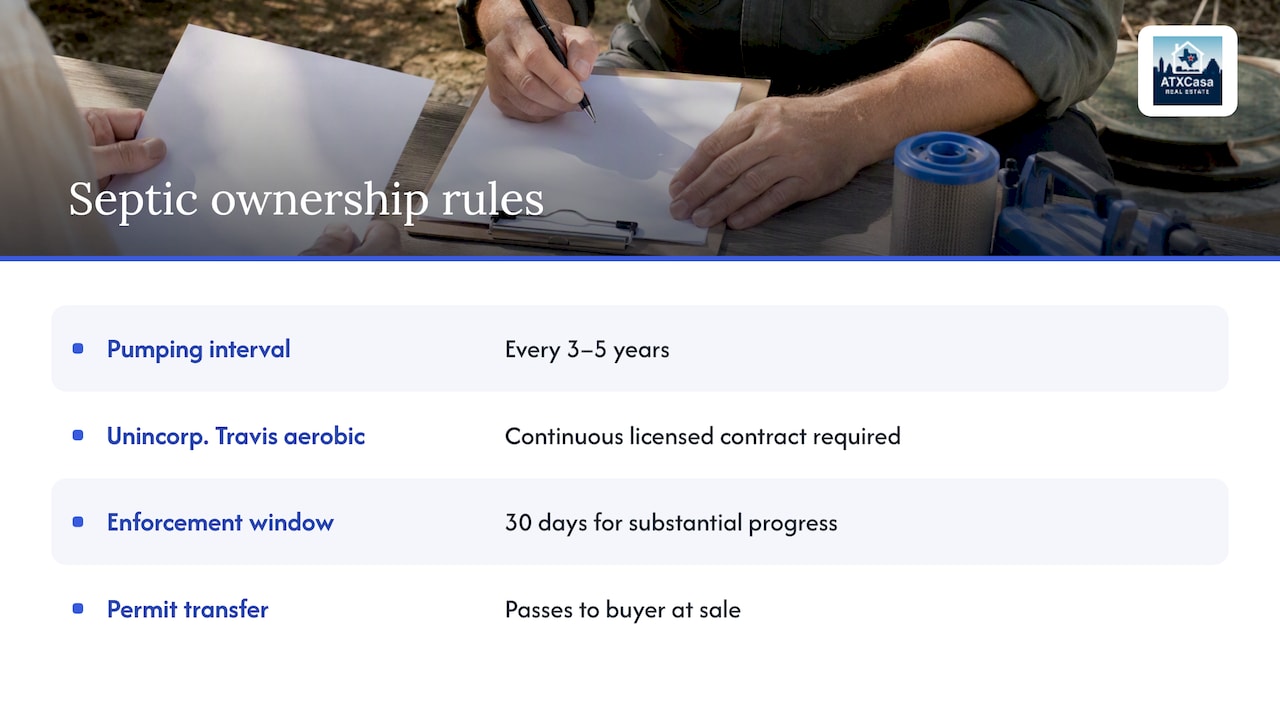
Pumping frequency. TCEQ recommends pumping every three to five years as general guidance. TCEQ’s published table gives intervals that vary with tank size and household size. For the home you are buying, confirm the pumping schedule using the system’s design, service records and local-authority requirements.
Maintenance contracts. In unincorporated Travis County, properties with aerobic systems are required by local regulation to keep a continuous, licensed maintenance contract, and homeowner self-maintenance is generally prohibited for those systems. Confirm the requirement for your specific address with the permitting authority, since rules differ between jurisdictions.
Enforcement. In its statewide guidance, TCEQ says an owner normally has 30 days to make substantial progress on remedies after problems are found. After that, the authorized agent can file a criminal complaint with the local justice of the peace. Confirm the requirements for a documented problem with the local permitting authority.
Permit transfer. TCEQ advises buyers to notify the local permitting authority after purchase that they are the new OSSF owner and ask about proper startup procedures. Before closing, request the permit and service records and confirm local requirements for the ownership change.
How to find out which system a home uses
Do this early, ideally before you write an offer.
- Read the listing and the seller’s disclosure. Look for the words septic, OSSF, aerobic or private sewer. Absence of a mention is not confirmation of sewer.
- Ask the seller for the permit, the as-built drawing and the maintenance records. These show system type, tank size and field layout.
- Check with the permitting authority. Inside Austin’s jurisdiction, that is Austin Water’s OSSF program. Outside, it is the county. Ask whether an OSSF record exists for the address.
- Look at the property. Access lids in the yard, a spray head field, a control panel on an exterior wall or an unusually soft, green patch are all clues.
- Ask your agent which utility serves the address. An address on a city street can still be outside the sewer service area.
If a home is in an extraterritorial area, expect a different oversight picture. One local construction-advice site notes that in many Austin ETJ areas no county agency reviews the building shell, structure or electrical work, while Travis County does permit septic systems under TCEQ Chapter 285. In practice, that puts more weight on your own inspections.
Septic inspection: what it covers and when to order one
A standard home inspection looks at the house, and septic systems are generally outside it. Ask your inspector in writing whether the system is in scope and what that means, then book a dedicated septic inspection if the home has one. The same goes for new construction that is not yet on city sewer. The scope of a builder-stage inspection differs from a final one, which I explain in our guide to pre-drywall versus final inspection scope.
A transaction-grade septic inspection typically includes:
- A pump-out, so the inspector can see the tank interior, baffles and components.
- Grading of the tank, the pump and control equipment, and the disposal area.
- A written report with photos.
The local septic company I cited prices that package at around $950 in the Austin and Travis County area. That is toward the high end of the $200 to $900 inspection range on national platforms, which probably reflects the included pump-out. Ask exactly what is bundled before you compare quotes.
Red flags to watch for
- Effluent surfacing in the yard, or odors near the tank or field.
- No maintenance contract or service records for an aerobic system.
- Gaps in required maintenance filings.
- A tank that has not been pumped in more than five years.
- A system too small for the house, for example after a bedroom addition. Ask whether the permit matches the current bedroom count.
Time matters because your option period is short. Order the septic inspection the first week, so a problem leaves room to renegotiate, ask for a credit, or walk away. The home’s insurance picture also matters, and I suggest running the insurance quote check during the same window.
Which one fits you
Sewer fits you if you want a predictable monthly bill, you do not want to manage service schedules, or you plan to resell quickly. Sewer is also what most financing and resale pools expect in dense Austin neighborhoods.
Septic fits you if you want acreage or privacy, you are comfortable keeping records and scheduling service, and you price in a reserve. A well-kept system on the right lot is not a defect. A neglected one is a liability.
Investors should treat septic as an operating line item: pumping, maintenance contract, and a replacement reserve. TCEQ guidance identifies excessive water use, food and grease loading, and poor maintenance as factors that can contribute to failure. I recommend addressing proper system use and maintenance responsibilities in the lease.
Sellers with septic can help buyers by gathering permits, contracts and pump-out receipts before listing. A pre-listing inspection two to four weeks out gives you time to fix issues on your terms.
Our perspective
We see septic questions arrive late, usually after a buyer has fallen for a property. By then the option period is ticking, and the seller has no records ready. Our approach is to ask the utility question at the first showing, because it changes the budget, the financing conversation and the inspection plan all at once.
We also think the debate is framed wrongly. The question is rarely which technology is better. It is whether this particular system, on this lot, with this maintenance history, is priced into the offer. A documented, recently pumped system with an active contract is a manageable expense. An undocumented one is an unknown, and unknowns should cost the seller something in negotiation.
My read: if the numbers are close, a buyer who wants simplicity should choose sewer, and a buyer who wants land should choose septic with eyes open and a reserve set aside. Vlad’s background in IT shapes how we work. We pull permit data, inspection findings and utility costs into one comparison, so the decision rests on documents rather than on impressions.
— Vladimir
Getting help with an Austin purchase or sale
If you are weighing a septic home against a sewer one, we can help you gather the permit history, line up the right inspections and set the offer terms around what we find. Start at ATXCasa, or browse our new construction and investment guides if you are comparing builds on larger lots. For rural acreage, our property survey guide explains what a survey costs and how it affects the disposal field and setbacks.
FAQ
Is septic better than public sewer?
Neither wins in every case. Sewer gives you a predictable monthly bill and no equipment to manage, while a maintained septic system can cost less over five years but carries replacement risk. Decide on the specific system’s age, type and records, not the category.
How much does a new septic system cost in the Austin area?
Angi reports an average of $8,599 for installation in Austin, with a stated range of $4,519 to $12,680, as of August 2026. Your cost depends on soil, system type and lot layout, so get a site evaluation and written quotes.
Does a standard home inspection cover the septic system?
Generally no. Ask your inspector in writing what is included, and book a dedicated septic inspection with a pump-out if the home has a system. A full local package runs about $950, and national averages for inspections range from $200 to $900.
How often should a septic tank be pumped?
TCEQ recommends every three to five years. Heavier use or an aerobic system under a maintenance contract may call for more frequent service. Follow your contract and your installer’s guidance.
Who pays for septic repairs after I buy?
You do, once the property changes hands, unless your contract negotiates a repair or credit. That is why the inspection should happen inside the option period, when you still have leverage.
Sources
- Basics for Septic Systems, TCEQ
- Advice for an Owner of an On-Site Sewage Facility, TCEQ
- On-Site Sewage Facilities, Austin Water
- Rates and Fees, Austin Water
- Proposed Budget 2027, City of Austin
- FY2025–2026 Austin Water rate document
- Legislation Text 19-1006, City of Austin
- Permitting Center, Travis County
- Preferred Wastewater Systems for the Texas Hill Country, Meadows Center
- Septic pumping cost in Central Texas (2026)
- Septic company in Austin (Travis County)
- Cost to pump a septic tank in Austin, Angi
- Cost to install a septic system in Austin, Angi
- Austin ETJ and your project