
If you rent a home in Austin for fewer than 30 consecutive days, you need a city operating license, and the city now has the tools to find you if you don’t have one. Short-term rentals are allowed in every residential zoning district as an accessory use, but only with a valid license, within the unit caps, and with local-contact, noise and tax obligations that fall on the owner. This guide walks through each rule as the City of Austin currently publishes it, then shows how to apply it if you are buying a property with an STR in mind.
TL;DR
- Residences rented for fewer than 30 consecutive days are short-term rentals. Owners and operators in Austin’s full-purpose and limited-purpose jurisdictions need a license from Austin Development Services. Properties in Austin’s extraterritorial jurisdiction (ETJ) do not need a City STR license; confirm the property’s jurisdiction before applying.
- The city lists a new license at $736.60 and a renewal at $369.60, valid for two years. Fees are non-refundable.
- An individual may operate up to 2 STR units on a single-family site; additional STRs operated elsewhere by that individual must be at least 1,000 feet apart. On a multifamily residential site, an individual may operate the greater of 1 unit or 10% of their units.
- Licenses do not make you tax-compliant: the owner still has hotel occupancy tax reporting duties to the city.
- Enforcement is increasingly automated, so an unlicensed listing is easy to match to an address.
Table of Contents
- What counts as a short-term rental in Austin
- Are Airbnbs allowed in Austin?
- Unit caps and the 1,000-foot separation
- How to get an Austin STR license
- Local contact and house rules
- Enforcement: how unlicensed listings get found
- Hotel occupancy tax: what the platform does and what you still owe
- Buying a home to use as an STR: a due diligence list
- Our perspective: treat the license as part of the purchase price
- If you are weighing an STR purchase in the Austin area
- FAQ
- Sources
What counts as a short-term rental in Austin
The City defines a short-term rental as a residence rented for fewer than 30 consecutive days. State hotel occupancy tax has a separate permanent-resident exemption for occupancy of at least 30 consecutive days. Its timing depends on written notice of the intended stay: without advance notice, state tax is due for the first 30 days.
For the same furnished home, a 28-night rental falls within the City’s STR definition, while an actual stay of at least 30 consecutive days falls outside it. That does not automatically make the entire longer stay exempt from state hotel occupancy tax: without advance written notice of the intended duration, tax is due for the first 30 days. If you offer shorter stays too, plan for STR licensing.
A “portion” of a unit counts too. Renting a spare bedroom on a nightly basis is still an STR, not a roommate arrangement.
Are Airbnbs allowed in Austin?
Yes, with a valid operating license. City guidance says Council adopted changes in February 2025 under which STRs are allowed as an accessory use in all residential zoning districts when they have a valid operating license. The guidance describes this as an additional use alongside residential uses in all zoning districts. The linked ordinance is Ordinance No. 20250227-039.
For investors, the practical shift is the removal of the old Type 1 versus Type 2 split for general residential zoning. Neighborhood-level density caps that once decided whether a license was available are no longer the main hurdle. The unit caps below are.
Unit caps and the 1,000-foot separation
The city’s current limits depend on the kind of site:
| Site type | STR limit |
|---|---|
| Single-family site | Up to two units |
| Additional single-family units | Require 1,000 feet of separation from other STRs |
| Multi-family site | The greater of one unit or 10% of total units |
A few examples show how the multi-family rule works. A 6-unit building can have one STR, because 10% is less than one unit and the rule gives you the greater figure. A 40-unit building can have four. A 100-unit building can have ten.
Before you offer on a property, check what the sites around it already hold. The separation rule is a distance test, so a neighbor’s licensed STR can limit what you can add. Ask the city or your agent to confirm current STR locations. The city also publishes open data on the general location of active short-term rentals, which is a good starting point, but verify directly with Development Services before you rely on it in a contract.
How to get an Austin STR license
The city’s Development Services Code Compliance division issues licenses. The process, in the order I would take it:
- Confirm the use fits. Check that the property is a residential dwelling and that your planned number of STR units fits the caps above.
- Confirm who can apply. The applicant must be able to meet the local-contact rules below, which is where many out-of-area owners get stuck.
- Gather property documents. The city’s licensing page lists the application requirements, so work from that list instead of a third-party checklist.
- Pay the fee. The city lists a new license at $736.60, made up of a $642.00 license fee and a $94.60 notification fee. Renewal is $369.60, made up of a $275.00 renewal fee and the same $94.60 notification fee. Licenses are valid for two years, and fees are non-refundable.
- Do not list until you are licensed. Treat the license number as a prerequisite to posting, not a follow-up task.
Fee schedules change, and some third-party guides quote different figures from earlier fiscal years. Treat the city’s page as the authority and check it on the day you apply.
Because fees are non-refundable, confirm eligibility and gather the required documents before applying. City STR operating licenses are non-transferable: a buyer must apply for a new license. If a warranty deed has been filed, email the City’s STRLicensing team for guidance. Allow for your own application before relying on rental income.
Local contact and house rules
A licensee or operator who lives outside the Austin Metro Area must identify a local contact to respond to emergencies, according to the city’s STR guidance. The contact must be in Travis, Williamson, Hays, Bastrop or Caldwell County and available to respond within 2 hours after notice of an emergency during any 24-hour period. This is a local-response requirement, not a blanket prohibition on an out-of-area owner managing bookings or other operations.
Post a physical information packet in a conspicuous common area with local-contact information and applicable rules, including noise, parking, trash, burn bans, water restrictions and Americans with Disabilities Act requirements. The City prohibits sound equipment above 75 decibels at the property line from 10 a.m.–10 p.m., and sound equipment audible beyond the property line from 10 p.m.–10 a.m. It also prohibits noise or musical instruments audible to an adjacent business or residence from 10:30 p.m.–7 a.m.
The city’s stated aim is to keep STRs from becoming a nuisance to neighbors. In practical terms, that means treating the property as a managed hospitality business rather than passive income. A few habits that follow from that:
- Put quiet hours and the noise limit in the booking message, not just the packet.
- Set a guest cap that matches the bedrooms and parking you actually have.
- Test your local contact’s response time before you list, not after the first complaint.
- Keep a written log of complaints and how you resolved them.
Enforcement: how unlicensed listings get found
Austin no longer waits for neighbors to call. In an April 30, 2026 memo to Mayor and Council, Development Services described its STR program update, including its use of Deckard Technologies to match online listings to physical addresses. The city prioritizes listings with nuisance complaints first, then works through other unlicensed listings.
Platforms are part of this. Third-party summaries point to a July 1, 2026 requirement that platforms show license numbers and remove unlicensed listings on city request, but confirm the current text with the city before you rely on that detail. The takeaway needs no confirmation: a listing with no license number is easy to find and likely to be flagged.
If you are evaluating an STR purchase, do not underwrite a pro forma that assumes a few months of unlicensed operation while the application is pending.
Hotel occupancy tax: what the platform does and what you still owe
Licensing is only half the compliance picture. A common mistake is assuming Airbnb or VRBO handles everything.
Here is the split as the sources describe it:
- State tax. Texas state hotel occupancy tax is 6%. The Texas Comptroller says platforms must collect and remit state hotel occupancy tax when they have agreed with the property owner to do so. Check your platform’s terms. For rentals through a platform that does not collect state tax, or through your own website, you must collect and remit it.
- City tax. Beginning April 1, 2025, platforms that book STRs and accept payment for the operator must also collect and remit the city’s Hotel Occupancy Tax. City tax is separate from the 6% state tax. City hotel occupancy tax is 11% on guest charges related to use, cleaning and readying of a room. Jurisdiction matters: STRs in Austin’s limited-purpose jurisdiction need a City license but are not subject to City hotel occupancy tax; those in its extraterritorial jurisdiction (ETJ) need neither a City STR license nor City hotel occupancy tax payments.
- Your filings. The owner still has quarterly reporting duties to the City of Austin, and skipped filings are a common trigger for an audit or license review. The city’s hotel and rental tax page sets out who must collect, remit and report. Bookings made outside a platform, such as direct bookings, are yours to collect and remit.
Keep your records clean from day one. Separate the property’s income and expenses from your personal accounts and track which nights were platform-collected and which were direct. A tool for rental property expense tracking that splits costs by use can help when a home is partly personal and partly rented. Whatever you use, share the records with a CPA who knows Texas hotel tax. I can explain how the rules work, but your tax filing is your accountant’s call.
Buying a home to use as an STR: a due diligence list
Most STR problems are found after closing. I would check these before the option period ends:
- Zoning and use. Confirm the lot is residential and the unit count you want fits the cap.
- Neighboring STRs. Confirm whether you would operate additional STRs elsewhere: those additional STRs must be at least 1,000 feet apart. The rule does not impose that separation simply because you operate a second STR unit on the same single-family site.
- License status. City STR operating licenses are non-transferable, so a buyer must apply for a new license. If a warranty deed has been filed, email the City’s STRLicensing team for guidance.
- HOA and deed restrictions. City permission does not cancel private covenants. Read the declarations, because an HOA can restrict rentals independently of the city.
- Local contact. If the licensee or operator lives outside Travis, Williamson, Hays, Bastrop or Caldwell County, identify a qualifying local contact before operating. Confirm that the contact can respond to emergencies within the required 2 hours.
- Revenue model. Underwrite with licensing fees, taxes, management costs and vacancy. Compare against a long-term rental, using our suburb rental yield analysis.
- Accessory dwellings. If the income plan includes an ADU, read our ADU lot checks first, because building rules and STR rules are separate approvals.
If you are leaving Austin and wondering whether to keep your home as a rental, our rent or sell checklist covers the longer-stay alternative, which sits outside the STR license framework.
Our perspective: treat the license as part of the purchase price
We come at this from a data-first view of Austin real estate. Vlad spent nearly two decades in IT before becoming a Realtor, and the habit that carried over is simple: test the assumption before you pay for it.
The assumption we see most often is that “STRs are legal in Austin” means “my STR is ready to run.” The city’s own materials say otherwise. Zoning permission is the first gate, but the license, the unit caps, the local contact, the tax filings and automated listing checks decide whether the income arrives.
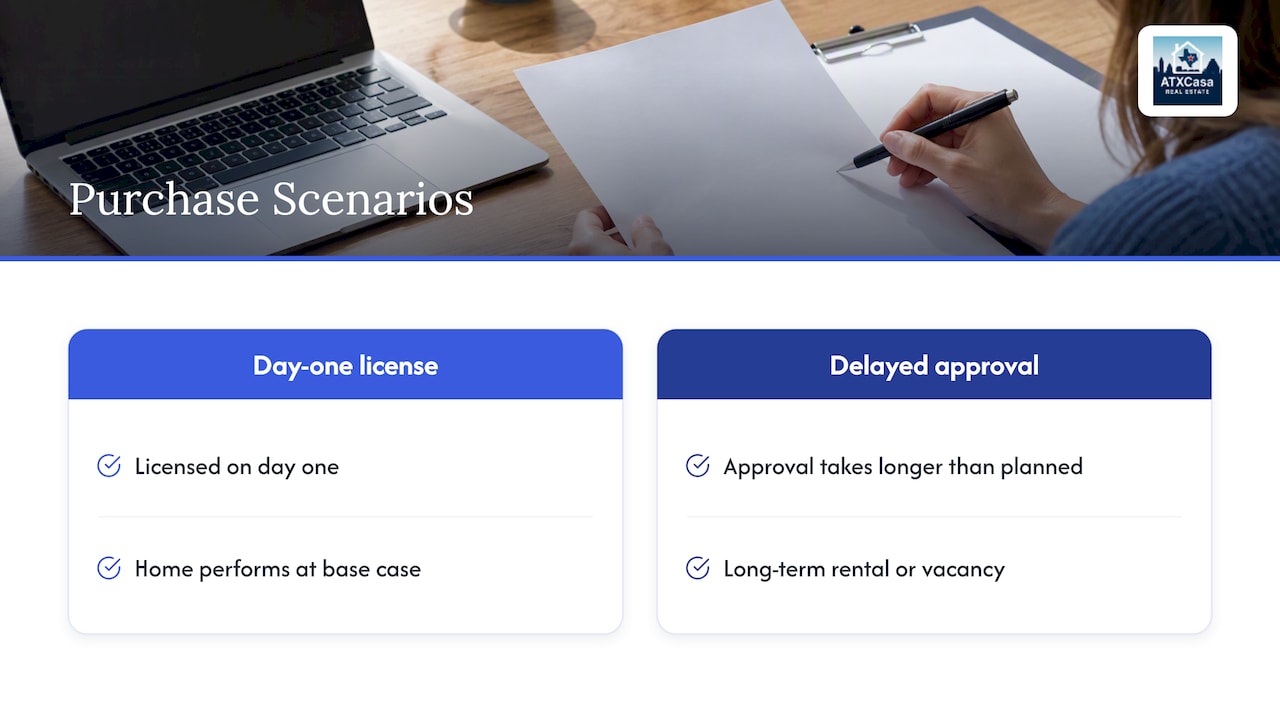
Our advice to investors is to model two cases. In the first, everything is licensed on day one and the home performs at your base case. In the second, approval takes longer than planned and you carry the property as a long-term rental or vacancy in the meantime. If the purchase only works in the first case, the price is too high for the risk.
For buyers who simply want a home and might rent a room occasionally, the same rule applies: under 30 days is an STR, even for one room and one weekend.
— Vladimir
If you are weighing an STR purchase in the Austin area
ATXCasa covers Austin, Cedar Park, Round Rock and Georgetown, and we can help you compare properties on price, neighborhood trends and the due diligence points above. Start with our Austin real estate guides and market updates, or get in touch through atxcasa.com if you want a second set of eyes on a specific property before you make an offer.
FAQ
What is the cost of a short-term rental license in Austin?
The city lists a new STR operating license at $736.60, which includes a $642.00 license fee and a $94.60 notification fee. Renewal is $369.60. Licenses are valid for two years and fees are non-refundable. Check the city’s page before applying, as fees can change.
How many short-term rentals can I have on one property?
An individual may operate up to 2 STR units on a single-family site and may operate additional STRs elsewhere if they are at least 1,000 feet apart. On a multifamily residential site, an individual may operate the greater of 1 unit or 10% of their units. The limit is based on the individual’s units, not automatically the building’s entire unit count.
Do I need to live in Austin to run an Airbnb here?
No. A licensee or operator who lives outside Travis, Williamson, Hays, Bastrop or Caldwell County must identify local contacts within that Austin Metro Area. Those contacts must be available to respond within 2 hours after notice of an emergency during any 24-hour period.
Does Airbnb pay all the taxes for me?
Do not assume so. For STRs subject to Austin hotel occupancy tax, the City requires platforms to collect and remit City tax on owners’ behalf, while owners must file quarterly City reports and directly collect and remit City tax on revenue from bookings outside online platforms. State tax works differently: a platform collects and remits it when it has agreed with the owner to do so; otherwise, the owner is responsible. Check the platform’s terms and keep records distinguishing platform collections from your own.
Sources
- Short-Term Rentals, Austin Development Services
- Memorandum: Update on Short-term Rental Program, April 30, 2026
- Ordinance No. 20250227-039, short-term rental use and regulations
- Hotel Occupancy Taxes, Austin Financial Services
- Hotel and Rental Tax, Austin Financial Services
- Hotel Occupancy Tax FAQs, Texas Comptroller
- Short Term Rental Locations, City of Austin Open Data