
Bidding wars still happen in Austin, but they are the exception rather than the rule. Well-priced homes in desirable neighborhoods can draw several offers, yet those offers rarely climb far above asking the way they did in 2021 and 2022. If you are buying, you have more room to negotiate than at any point since the pandemic. If you are selling, you should price for competition without counting on it.
Below I walk through what the current data says, where multiple offers still show up, how to build an offer that holds up in a competitive situation, and how sellers should compare the offers that arrive.
TL;DR
- Unlock MLS reported 5.1 months of inventory in the Austin-Round Rock-San Marcos MSA in August 2026. This MLS-only measure does not quantify bidding wars.
- Multiple offers still appear on well-priced homes in desirable, low-inventory neighborhoods, but usually not far over asking.
- Buyers compete best with clean terms, a strong pre-approval and a sensible plan for the option period, not by overpaying.
- Sellers should compare price, financing, contingencies, timeline and earnest money, because the highest number is not always the strongest offer.
Table of Contents
- What bidding wars look like in Austin now
- Where multiple offers still happen
- How to tell whether a home will draw multiple offers
- How to make a competitive offer without overextending
- What sellers should compare when offers arrive
- How the market got here
- Our perspective
- Working with ATXCasa
- FAQ
- Sources
What bidding wars look like in Austin now
During the pandemic-era peak, it was routine for Austin homes to receive many offers and sell well above list. That is not today’s market. CultureMap Austin reported in May 2026 that buyers were seeing more competition on well-priced listings, but not offers significantly over asking, and it described conditions as materially calmer than the pandemic period.
The broader picture agrees. Business Insider’s August 2026 coverage describes a market where sale prices have corrected from their peak, inventory has grown and negotiating power has returned to buyers, although homes in core neighborhoods still see occasional competition.
That last part matters. “Calmer” is not “over.” A buyer who assumes every listing is negotiable will lose the few that are not, and a seller who assumes there is no demand will underprice a home that deserves a strong response.
The numbers behind the shift
The figure I watch first is months of inventory: active listings divided by the monthly pace of sales. It tells you how long it would take to sell every home on the market at the current rate. In its MLS-only August 2026 report, Unlock MLS reported 5.1 months of inventory for the Austin-Round Rock-San Marcos MSA. This regional measure describes supply relative to sales, not how often homes receive multiple offers.
A simple example shows how to read it. If an area has 1,200 active listings and 300 sales a month, that is 4 months of inventory. At 600 sales a month it is 2 months. The same listing count feels very different to a buyer in each case. For the current local picture, see our Austin housing inventory update.

The same source notes that buyers in 2026 have regained negotiating power, with common concessions including seller-paid closing costs, rate buydowns and repair credits after inspection. Those concessions are the opposite of what a bidding war produces, which is a useful signal in itself: when sellers are paying for buyer costs, most of the market is not in a multiple-offer mode.
Where multiple offers still happen
Competition in Austin is not evenly spread. It follows a few predictable patterns.
Neighborhoods with good schools and few listings
Business Insider reported in August 2026 that desirable Austin neighborhoods with good schools and fewer listings could still attract multiple offers, though local participants said the situation was not close to the intensity of the 2022 bidding wars. That fits what I see: scarcity, not the metro average, creates competition. A neighborhood with two active listings and a steady stream of relocating families behaves differently from a new-construction subdivision with dozens of unsold homes.
Central Austin, below a price ceiling
A Property Innovation Journal report from April 2026 claimed that 10% to 20% of central Austin single-family homes priced below $2 million were attracting multiple offers. That figure comes from one local group’s transaction experience, so treat it as a practitioner estimate, not a citywide statistic. Even so, it points in a useful direction: competition concentrates in central, well-priced homes, and it is much thinner at the high end and in far-out suburbs with heavy supply.
Homes priced right from day one
Price is the other driver. A home listed at a realistic number, in good condition, with strong photos and an accessible showing schedule, is the one that draws a second offer. Listing agents are also becoming more selective in 2026, according to Business Insider, and may avoid properties that have sat for a long time or need significant unresolved repairs. Stale or problem listings tend to see negotiation, not competition.
What rarely sees bidding wars
- New construction with builder inventory and incentives
- Homes that have been reduced more than once
- Properties with visible deferred maintenance
- Listings priced above what recent sold data supports
If you are searching in the Cedar Park, Round Rock or Georgetown areas, the same logic applies at the subdivision level: check supply on the specific street and price band, not just the city headline.
How to tell whether a home will draw multiple offers
No single statistic predicts it, and I would be wary of anyone who claims one does. I use a short checklist of local data points that, taken together, give a reasonable read before you write an offer.
- Months of inventory in the specific area and price band. Under about four months suggests competition; over six suggests leverage. Look at the narrow segment, such as a ZIP code and a price range, not the metro.
- Days on market for comparable homes. If similar homes went pending in under a week, expect competition. If they sit for 45 days or more, expect negotiation.
- Close-to-list price on recent sales. If comparable homes closed at or above list, that is a competitive pocket. If most closed several percent below list, you probably have room. Our guide on using Austin sold-home data shows how to pull and read these comparables.
- Price relative to recent comps. A home listed under its comparable sales is the most likely candidate for multiple offers.
- How the listing agent is handling it. An offer deadline, a short showing window or a note about reviewing offers on a specific date are direct signs that the agent expects more than one.
- Condition and presentation. Move-in ready homes with professional photos draw more traffic than those that need work.
If four or more of these point toward competition, I advise clients to prepare as if there will be other offers. If most point the other way, there is usually no reason to overpay or rush.
How to make a competitive offer without overextending
When there are multiple offers, price is only one factor; the strongest offer may not be the highest-priced because financial terms, contingencies, earnest money and timing can matter to the seller. Here is how I would structure an offer.
Start with financing strength
Get a full pre-approval, not a pre-qualification, and have your lender ready to confirm quickly. A local realtor guide on competing in Austin’s multiple-offer market, published in April 2026, makes the same point about financial cushion: showing a seller you can absorb an appraisal gap can strengthen a bid. I would only offer that cushion if the number fits comfortably in your budget. Covering a few thousand dollars above an appraisal is a business decision, not a reflex.
Understand the earnest money and option period
Texas contracts give buyers a defined way to protect themselves, and it pays to know it before you write terms. Under the TREC New Home Contract, a buyer has an unrestricted right to terminate during the option period if they pay the option fee. The same form requires timely delivery of earnest money and the option fee, and strict compliance with the time requirements is required. The resale contract works on the same principle, though the specific form differs, so confirm which form applies to your purchase with your agent.
In practice that means:
- Option fee: a negotiated payment to the seller for the right to terminate and keep your earnest money. A larger fee, or a shorter option period, can make an offer more attractive.
- Earnest money: a deposit that shows commitment. A larger deposit signals strength, but it is at risk if you miss a deadline or default outside your protections.
- Deadlines: missing the delivery window can weaken your protection. Set calendar reminders the day the contract is executed.
We break down the differences, and the three-day deadline, in earnest money vs option fee.
Make the terms easy to say yes to
Price is only one lever. Others a seller may value:
- A flexible closing date or a short rent-back after closing
- Fewer or cleaner contingencies, such as a realistic financing timeline
- A larger earnest money deposit
- An inspection plan that focuses on major issues, not cosmetic ones
- A short, personal letter only if your agent thinks it helps; keep it about the home, not about you
Do not waive protections you cannot afford to lose. Waiving the inspection entirely, or agreeing to cover an unlimited appraisal gap, can cost far more than losing a house. If a home has foundation, drainage or roof concerns, which are common in the area, an inspection and, where warranted, a structural engineer’s opinion during the option period are worth the cost. For a broader plan, see our Austin homebuyer strategy guide.
Know when not to compete
If you lose a home because you refused to overpay, that is not a failure. In today’s inventory, another one will likely come. We discuss the negotiating side of this in whether it is easier to buy a home in Austin in 2026, and the pricing side in our look at Austin home prices in 2026.
What sellers should compare when offers arrive
If you receive more than one offer, price is the first line of the comparison, not the last. NAR’s consumer guide on navigating multiple offers notes that the strongest offer may not be the highest-priced one. Compare these items side by side:
| Factor | What to look at |
|---|---|
| Offer price | The number, and how much of it depends on an appraisal |
| Financing | Loan type, down payment, pre-approval quality, any appraisal gap coverage |
| Contingencies | Financing, appraisal, sale of the buyer’s current home |
| Closing timeline | Does the date fit your move? |
| Earnest money and option fee | Size of each, and the option period length |
| Seller concessions | Requests for closing costs or repair credits |
A seller prioritizing a simpler transaction may prefer an all-cash offer, while a seller seeking a quick move may value a quicker closing timeline. Compare each offer’s terms against your stated priorities. Ask your agent to build a net sheet for each offer so you can also compare what you would keep after costs.
Before you list, decide your strategy. Some sellers set an offer deadline to concentrate interest. Others take the first strong offer. In a balanced market, I would be careful with artificial urgency if the home has been sitting. If you are weighing a price cut against helping with buyer costs, our piece on price cut or closing-cost help compares both. And our seller checklist covers preparation that helps a home attract competition in the first place.
How the market got here
The path from 2021 to 2026 explains why expectations are still adjusting. During the peak, low rates and heavy in-migration pushed prices up sharply and made offers well over asking common. Since then, prices have corrected, inventory has increased and, as Business Insider summarizes, negotiating power has shifted back to buyers.
The lag in expectations matters on both sides. Some sellers still anchor to a neighbor’s 2022 sale. Some buyers still expect to lose every home. Both anchors cost money. The better reference is the last 60 to 90 days of comparable sales in the same neighborhood. The broader context is in our Austin housing market overview.
Our perspective
We built ATXCasa around a simple view: a bidding war is a local, temporary condition, not a market-wide fact, and it should be measured before it is feared. Vlad brings nearly two decades of IT experience to that work, so we look at months of inventory, days on market and close-to-list price by neighborhood, then decide what the data supports.
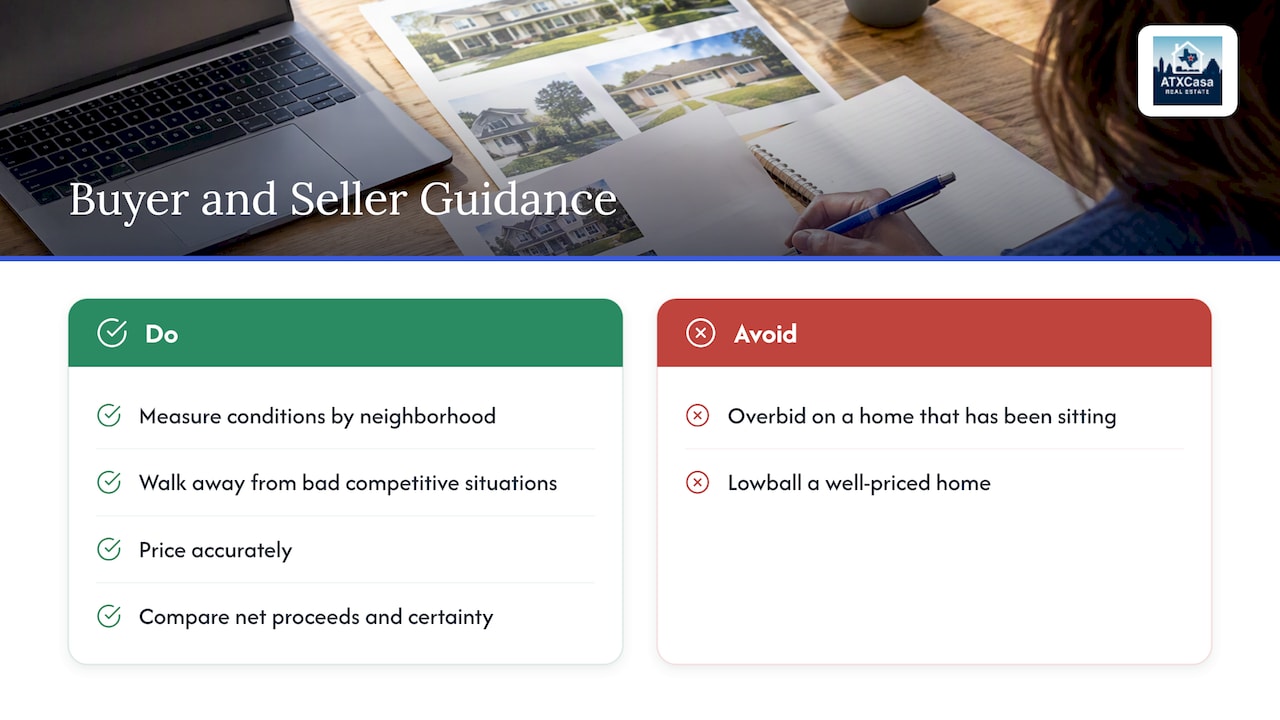
Our read of Austin right now is this. Most buyers have more leverage than they believe, and a small set of homes in desirable, low-supply pockets still reward a fast, clean offer. The mistake we see most often is treating both situations the same way: overbidding on a home that has been sitting, or lowballing a home that is priced well and has four showings booked on the first weekend.
For buyers, we would rather help you walk away from a bad competitive situation than win it at any cost. For sellers, we would rather price accurately and compare offers on net proceeds and certainty than chase a headline number. Transparency about what the data does and does not show is the point of everything we publish.
— Vladimir
Working with ATXCasa
If you are buying, selling or investing in Austin, Cedar Park, Round Rock or Georgetown, we can pull the sold data, inventory and days-on-market figures for your specific neighborhood and price range before you make an offer or set a list price. That tells you whether you are facing real competition or just a listing that looks busy.

To talk through your situation, visit ATXCasa.
FAQ
Are there still bidding wars in Austin?
Yes, but they are limited. Well-priced homes in desirable neighborhoods with few listings can still draw multiple offers, according to Business Insider’s 2026 reporting. Those situations are far less intense than in 2022, and offers significantly over asking are uncommon.
Should I waive the inspection to win a multiple-offer situation?
I would not do it as a default. In Texas, the option period lets you inspect and, if you paid the option fee, terminate. A shorter option period or a larger option fee can strengthen your offer with less risk than giving up the inspection entirely. Talk through the specifics with your agent and, if needed, a real estate attorney.
What is the strongest offer if price is not the only factor?
It is the one most likely to close on time and as written. Strong financing, a reasonable earnest money deposit, limited contingencies and a closing date that fits the seller’s plans all count. NAR’s guidance says the highest-priced offer is not always the strongest.
How can I tell if my target home will get multiple offers?
An offer deadline may be part of a seller’s negotiation strategy; it does not by itself prove there are competing written offers. Ask your agent about the listing and, where applicable, how other offers are disclosed.
Is Austin a buyer’s market in 2026?
For August 2026, Unlock MLS reported 5.1 months of inventory for the Austin-Round Rock-San Marcos MSA. Conditions vary by geography and property type, and this MLS-only measure does not establish how many homes receive multiple offers.
Sources
- CultureMap Austin: 6 Austin-area ZIP codes with rising affordable home sales
- Mortgage Austin: Austin housing market update for buyers
- Business Insider: Austin’s real estate bust
- Property Innovation Journal: Austin housing inventory tightens despite oversupply
- TREC: New Home Contract (Incomplete Construction)
- NAR: Consumer guide to navigating multiple offers