

To price your home in Austin, start with closed sales of similar homes nearby from the last 12 months, adjust for condition and location, then set an asking price that matches what buyers are actually paying now, not what sellers hoped for last year. In September 2026, Austin-area homes closed at an average of 92.7% of their original list price, so an asking price built on optimism usually ends in a price cut.
I work with Austin-area sellers in Cedar Park, Round Rock, Georgetown and the city itself, and the pricing conversation is the most important one we have. Below is the process I use, the market numbers behind it, and how to adjust if the offers do not come.
TL;DR
- Build your price from at least three closed comparable sales from the last 12 months. Active listings show competition, not value.
- As of September 2026, the Austin-area median sales price was $421,000 and homes closed at an average of 92.7% of original list price, with 5.4 months of inventory.
- Overpricing is costly in this market: the typical Austin price reduction reached 5.9% from the original ask in early 2026.
- Choose a pricing strategy before you list, and set a review date (I suggest two to three weeks) for adjusting based on showings and feedback.
- Neighborhood, condition and competing listings can move your number far more than the metro median can.
Table of Contents
- What the Austin market says about pricing right now
- Step 1: Pull the right comparable sales
- Step 2: Adjust for your home’s condition and features
- Step 3: Choose a pricing strategy
- Step 4: Read your showing activity and adjust
- Common pricing mistakes in Austin
- Our perspective
- Work through your price with us
- FAQ
- Sources
What the Austin market says about pricing right now
The metro numbers set the backdrop, though they never price your house. According to the September 2026 Central Texas Housing Report from Unlock MLS, closed sales declined 14.8% year over year to 2,223, the median sales price rose 1.4% to $421,000, homes closed at an average of 92.7% of their original list price, and inventory stood at 5.4 months.
Those four figures tell a consistent story:
- Fewer buyers are closing. A drop of nearly 15% in sales means each listing competes for a smaller pool of buyers.
- Prices are holding at the metro level. A 1.4% gain in the median is not a crash, and it is not a surge.
- Sellers are not getting full asking price. An average of 92.7% of original list price means the gap between ask and sale is, on average, about 7%.
- Supply is ample. At 5.4 months of inventory, buyers have real choices. A common rule of thumb treats roughly six months as a balanced market, so we are close to balance with a buyer lean in many price bands.
Asking prices have moved too. Austin had the largest year-over-year drop in median listing price among the nation’s 50 largest metros in September, with asking prices down 9.8% to $446,450, according to a Realtor.com report covered by the Houston Chronicle. That same report found 20.8% of active listings nationally had a price reduction in September, the highest share for that month since 2018.
The Texas Real Estate Research Center describes a market that has cooled and is neither decelerating nor accelerating. Higher mortgage rates have squeezed affordability, rising inventory has given buyers more leverage, and sellers increasingly compete with one another for price-sensitive buyers.
For a deeper look at where supply stands, see our Austin housing inventory update, and for the bigger price picture, our piece on Austin home prices and negotiating room.
Step 1: Pull the right comparable sales
Comparable sales, or comps, are the foundation of any defensible price. Three rules keep them honest.
Use closed sales, not listings
A closed sale is what a buyer actually paid. A current listing is what a seller hopes to get. Lenders and appraisers follow the same logic. Fannie Mae’s Selling Guide requires at least three closed comparable sales in the sales comparison approach and says sales that closed within the last 12 months should be used. It allows an older sale when it is the best indicator of value and the reason is explained. Current listings and contract offerings can serve as supporting data but cannot replace the three closed sales.
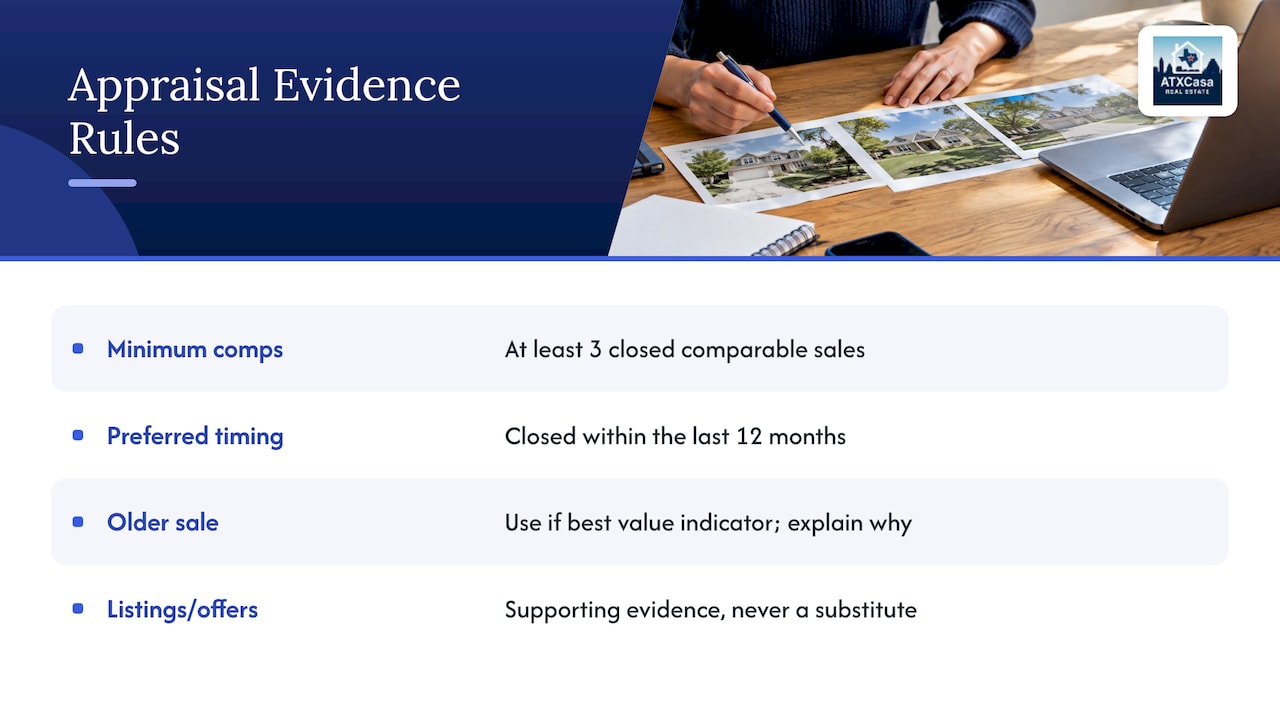
This matters to you as a seller because your buyer’s lender will order an appraisal built on this kind of evidence. If your price rests on listings or on a neighbor’s wishful ask, the appraisal can come in below your contract price, and that renegotiation costs time.
Stay close in space, size and age
In Austin, a few blocks can change value more than a few hundred square feet. School zones, flood and traffic exposure, proximity to employment centers and lot characteristics all differ street to street. I start with homes within a half mile or within the same subdivision, then widen only if I lack enough sales.
A sensible comp set looks like this:
- Same subdivision or immediate neighborhood, closed within the last 3 to 6 months where possible.
- Square footage within roughly 10 to 15% of yours.
- Similar age, lot size and bedroom and bathroom count.
- Similar condition, which is the hardest filter and the one most sellers skip.
Our guide to using Austin sold-home data to price your property walks through this filtering in more detail, and our look at neighborhood price patterns across the Austin metro shows how widely sold prices vary between areas.
Compare original list price to final sale price
The sale price alone hides the story. For each comp, note the original list price, how many days it sat, whether it was reduced, and where it closed. A comp that sold for $430,000 after two reductions from $465,000 is evidence of what buyers would not pay at $465,000, which is just as valuable.
Step 2: Adjust for your home’s condition and features
Once you have your comps, you adjust. A comp with a renovated kitchen is worth more than your 2005 kitchen; a comp backing to a busy road is worth less than your quiet cul-de-sac. There is no universal dollar value for any feature in Austin. Values vary by price band and neighborhood, which is why I avoid quoting a flat number for a pool or a new roof.
Here is how I think about the major categories:
- Condition: Deferred maintenance gets discounted by buyers at more than the repair cost, because they price in hassle and uncertainty. Fixing visible, inexpensive items before listing usually protects your price.
- Major systems: Roof age, foundation, and HVAC come up in nearly every inspection. In Austin’s heat, a failing air conditioner is a serious negotiating point. For a practical walk through the replace-or-not decision, see this explainer on replacing the AC before selling.
- Upgrades: Kitchens, baths, flooring and fresh paint matter most when they bring your home level with the best comps. They rarely lift you far above the neighborhood ceiling.
- Lot and location: Size, views, tree cover, orientation and street noise are real value factors, and a good comp set captures them automatically.
Do not forget new construction
Your competition includes builders. Research from the Texas Real Estate Research Center at Texas A&M found that in November 2018 Austin became the first major Texas metro where the median price of new homes sold fell below that of existing homes, and that after accounting for location, house size and lot size, new homes were more expensive than existing homes in most of the city’s local market areas. The lesson for a resale seller is to compare your home with nearby new builds on a like-for-like basis, since buyers will do exactly that, often with builder incentives on the table.
Step 3: Choose a pricing strategy
With a value range in hand, you decide where in the range, or relative to it, to list. Here are the three approaches I discuss with clients.
| Strategy | How it works | Best when | Main risk |
|---|---|---|---|
| Price at market value | List at the figure your closed comps support | Most homes, especially in a market with ample inventory | You leave less negotiating cushion |
| Price slightly below value | List a bit under comps to draw early traffic and possible multiple offers | Homes in high-demand pockets with low local supply | Works only if demand is truly strong where you are |
| Price above value | List high and plan to come down | Unique homes with few comps | Stale listing, and a cut that signals weakness |
In the current Austin market, I lean toward the first approach for most sellers. The data explains why. The Texas Real Estate Research Center reports that the typical Austin price reduction reached 5.9% from the original asking price in the first four months of 2026, and that 69% of closed sales in Austin in 2025 closed at prices at least 3% below sellers’ initial ask prices.
A worked example
Suppose your comps point to a value of about $450,000.
- If the market average of 92.7% of original list price held for your home, listing at $450,000 would imply a sale near $417,150, which is $32,850 below your value. That average covers all homes, including overpriced ones, so it is a warning, not a forecast.
- A 5.9% reduction from a $450,000 ask would be about $26,550, which would bring the price to roughly $423,450. A seller who listed at $450,000 and cut that much would have lost weeks of market time first.
- A seller who lists at $450,000 and gets an offer in the first two weeks, at or near ask, has priced to the market.
The point is not that every home loses 7%. It is that the first price you choose sets your timeline, and in a market with this much inventory the first two weeks carry the most buyer attention.
Step 4: Read your showing activity and adjust
Every listing generates information. Treat it as feedback on your price, not on your home’s worth.
- Days one to fourteen: Watch showings, online views and saves. Strong traffic with no offers often means the price is slightly high. Weak traffic means the price is well off, or the photos and description are failing.
- Feedback pattern: If several agents say the home is nice but pricey, believe them. If feedback focuses on condition or layout, a price change may not fix it.
- Review date: Set it before you list. I suggest a conversation at two to three weeks, comparing your home with new listings and new closings in the same area.
- Make the cut count: A token reduction rarely changes buyer behavior. Move the price to where it lands in a new search bracket or clearly below the competing homes.
Price cut or closing-cost help?
Sometimes the better lever is not the list price. If buyers are stretched by monthly payments under high mortgage rates, a seller contribution can solve a problem that a smaller price cut does not. I compare both in our article on Austin sellers choosing between a price cut and closing-cost help.
Common pricing mistakes in Austin
- Anchoring to the peak. Neighbors’ 2021 and 2022 prices belong in the history, not in your comp set.
- Using the metro median as your price. The $421,000 figure covers the whole region and every home type. Your home sits in a specific neighborhood and price band.
- Counting active listings as comps. They show competition, not value.
- Pricing off an online estimate. Automated estimates cannot see your kitchen, your lot or your street.
- Ignoring the cost of waiting. Carrying costs, including mortgage, taxes, insurance and utilities, accrue every week the home sits.
- Over-improving before sale. Spending heavily on upgrades above the neighborhood ceiling seldom returns the full cost.
Our perspective
Most pricing mistakes we see start with a number the seller already has in mind. We start from the opposite end: closed sales, days on market and how far the final price landed from the original ask. Then we work back to a list price.
Our approach combines nearly two decades of IT experience with local market knowledge. We look at the data first, whether that is sold listings in your subdivision, current inventory in your price band or how recent reductions have played out, and we explain what each figure means for you in plain language.
In a market where homes close below original list price on average, we believe the strongest position is a price you can defend with evidence. A defendable price attracts buyers in the first weeks, holds up at appraisal and keeps negotiations about details rather than about whether the number makes sense. That is the transparent, stress-free process we aim to give every seller.
Vladimir
Work through your price with us
If you are planning to sell in Austin, Cedar Park, Round Rock or Georgetown, we can build a comp-based price range for your specific home and show you the closed sales behind every figure. We combine local market insight with data-driven pricing and AI-powered marketing designed to give your listing broad exposure from day one.

Start at ATXCasa to talk through your timeline and pricing options.
FAQ
How do I find out what my Austin home is worth?
Gather at least three closed sales of similar nearby homes from the last 12 months, then adjust for differences in condition, size and lot. Automated online estimates can serve as a rough starting point, but they cannot see your home’s condition or street. A local agent can pull the full closed-sales data and walk you through the adjustments.
Should I list my Austin home above market value to leave room to negotiate?
In the current market, I generally advise against it. Inventory stood at 5.4 months in September 2026, and the typical Austin reduction reached 5.9% in early 2026, so buyers see plenty of alternatives and often wait for cuts. A price that matches your comps tends to bring stronger offers early.
How long should I wait before lowering the price?
Set a review point before listing, typically two to three weeks. If showings are strong but offers are absent, the price is probably a bit high. If showings are weak, consider the price, photos and presentation together. Then compare your home with new listings and recent closings before deciding how large a reduction to make.
Do upgrades increase my asking price in Austin?
They can, mainly when they bring your home level with the best comparable sales in your neighborhood. Visible deferred maintenance and aging major systems, such as HVAC, tend to cost sellers more at negotiation than they would cost to fix. Spending beyond the neighborhood’s price ceiling rarely pays back in full.
Are Austin home prices going down?
It depends on the measure and the area. The Austin-area median sales price rose 1.4% year over year to $421,000 in September 2026, while median asking prices fell 9.8% to $446,450. Neighborhood and price band matter more than the headline, so check sold data for your own area. Our Austin housing market overview tracks the local numbers.
Sources
- September 2026 Central Texas Housing Report, Unlock MLS
- Housing, Summer 2026, Texas Real Estate Research Center
- Austin Home Price Illusion, Texas Real Estate Research Center
- Comparable Sales, Fannie Mae Selling Guide
- Austin home prices fall 9.8 percent, Houston Chronicle
- Selling Your Home: Should You Replace the AC or Furnace First?