
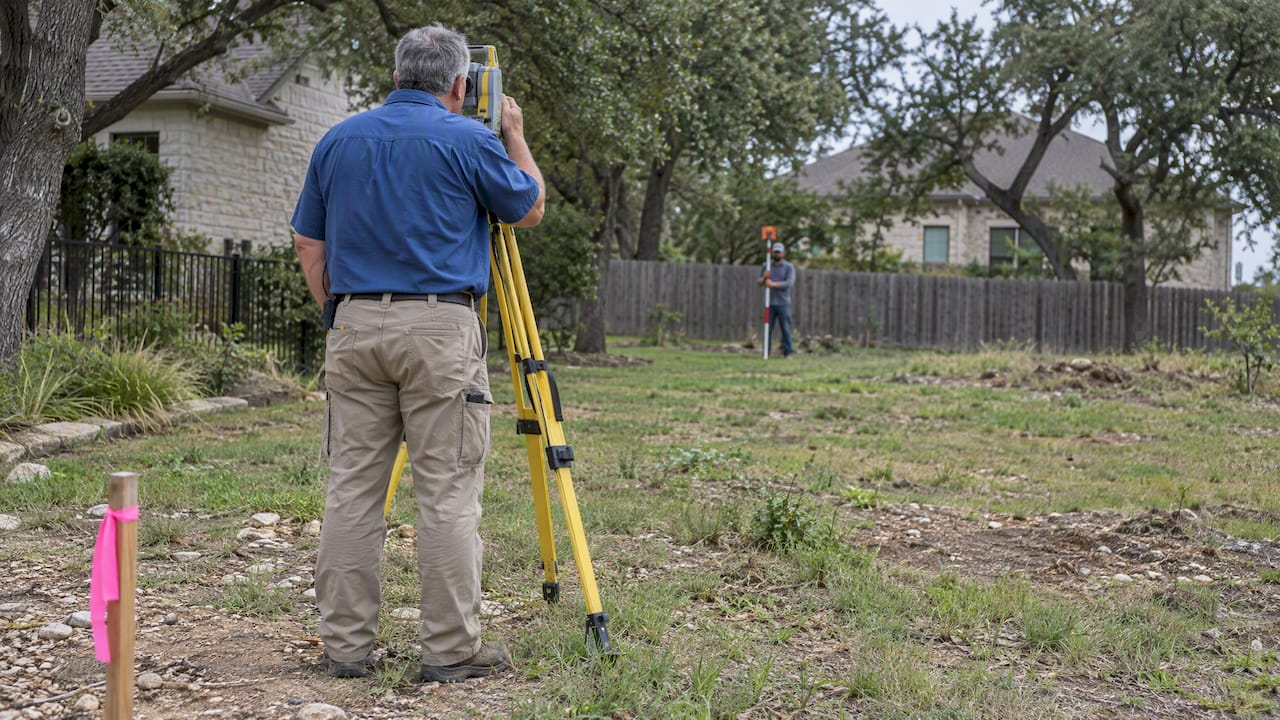
If you’re buying or selling in Austin, confirm early whether the buyer, lender, and title company will accept the existing survey. Final Texas professional surveying work must bear the responsible surveyor’s seal, signature, and date; acceptance of an older survey is a separate decision. Check whether the drawing reflects current permanent improvements and what documentation the parties require before relying on the seller’s copy.
TL;DR:
- A boundary survey must include monuments tied to the deed to ensure boundary accuracy and avoid drift over time.
- Land-title or ALTA surveys are required for high-value transactions and depend on current title commitments, unlike basic boundary surveys.
- Angi’s August 4, 2026 estimate for a one-acre Austin land survey is $1,600 to $3,700. Survey scope, property size, and site conditions affect the estimate.
- Texas professional surveying work must be performed under the responsible registered or licensed surveyor and, for final Texas work, released with the responsible registration holder’s required seal, signature, and date. Verify the professional’s status with the Texas Board before hiring.
- Confirm lender and title company requirements early to avoid delays, and provide existing records like deeds, prior surveys, and permits to improve survey accuracy and pricing.
Table of Contents
- What a Property Survey Includes and Why It Matters in Austin
- Choosing the Right Type of Survey for Your Transaction
- How Much a Survey Costs in Austin and What Drives the Price
- Verifying Your Surveyor’s Texas Credentials
- Preparing Your Documents Before Requesting Bids
- Can You Use an Existing Survey, or Do You Need a New One?
- When Land Division Requires More Than Just a Survey
- What I Tell Austin Buyers and Owners About Surveys
- Where to Verify Licensing, Survey Rules, and Local Platting Guidance
- Sources
- FAQ
What a Property Survey Includes and Why It Matters in Austin
A survey that will actually hold up at closing is more than a drawing of your lot. Title companies and lenders look for specific elements before they will rely on it, and buyers should look for the same things before accepting a seller’s copy.
For survey coverage under National Investors Title’s checklist, the minimum items include:
- Property address and complete legal description
- The survey date, drawing scale, and official seal; Texas Board rules require the responsible surveyor’s seal, signature, and date on final professional surveying work
- Monuments found or set, with the property boundaries shown to scale according to the record description
- Location and description of improvements, including driveways, fences, and detached buildings
- Easements, setback lines, and encroachments shown as specified in the checklist
Monuments matter more than they sound like they should. A monument, a physical marker like an iron rod or concrete block, anchors the boundary on the ground in a way that a paper description alone cannot. Surveys that only cite coordinates without monumentation can drift in interpretation over time, which is one reason survey checklists for Texas call for monuments to be identified and tied to the deed. These elements also give title insurers a basis for excepting or covering specific boundary issues, and they give lenders confidence that the collateral is accurately described.
Choosing the Right Type of Survey for Your Transaction
Not every transaction needs the same survey product, and paying for the wrong one wastes money and time. Here is how the main types break down for Austin buyers and owners.
- Boundary survey: Establishes property lines and is the baseline most residential sales rely on.
- Land-title or ALTA/NSPS survey: A more detailed deliverable that lenders and title companies often require for commercial deals or higher-value transactions, since it ties boundary work to a current title commitment.
- Topographic survey: Maps elevation and natural features, used for drainage planning or site design rather than title purposes.
- As-built or construction staking survey: Documents structures already built or marks locations before construction begins.
The TSPS Manual of Practice notes that a land-title survey depends on a current title commitment and requires boundary research beyond what a standard boundary survey covers. Sending a surveyor only an address, without that title information, typically produces an incomplete quote. Topographic work and construction staking, while useful, are distinct from sealed boundary determination and generally cannot substitute for a boundary survey when title insurance is on the line.
How Much a Survey Costs in Austin and What Drives the Price
A one-acre Austin land survey is estimated at $1,600 to $3,700, according to Angi’s Austin pricing data, updated August 4, 2026. Angi derives its local estimates from national project-cost inputs and local price-index data. This is a modeled estimate, not a binding quote; survey type, property size, and site conditions affect pricing.
Several factors push a quote up or down:
- Survey type: a land-title or ALTA survey costs more than a basic boundary survey.
- Acreage and shape: larger or irregular parcels take longer to measure and research.
- Site difficulty: dense brush, steep grade, or limited access adds field time.
- Research complexity: unplatted land or metes-and-bounds descriptions require extra title work.
- Monumentation: setting new monuments costs more than confirming existing ones.
Labor often makes up a large share of the total, and local Austin pricing can run higher than some national averages because of demand. To compare quotes fairly, ask each surveyor what deliverable you’ll receive, the turnaround time, whether title research is included, and whether new monuments will be set or only existing ones verified.
Verifying Your Surveyor’s Texas Credentials
Boundary and property surveying in Texas is regulated work. A registered or licensed surveyor may seal only work performed by them or under their direct supervision. Texas surveying work issued by a registration holder must include that holder’s Registered Professional Land Surveyor (RPLS) seal. Before hiring anyone, confirm their Board status through the Texas Board of Professional Engineers and Land Surveyors, which maintains license lookup tools for both individuals and firms.
For final Texas professional surveying work, Board rules require the responsible surveyor’s seal, signature, and date before release. This isn’t a formality: title companies generally require it before they will rely on the survey for insurance purposes.
Before signing a contract, ask the surveyor:
- Are you currently licensed as an RPLS in Texas, and can I verify that through TBPELS?
- Do you carry professional liability insurance?
- Have you filed surveys with Travis County or the City of Austin recently?
- What is your monumentation strategy, meaning will you set new markers or rely on existing ones?
- What does the final deliverable include, and how long will it take?
Pro Tip: Ask for a sample deliverable from a recent Austin-area job before you commit, so you know exactly what the final product will look like.
Preparing Your Documents Before Requesting Bids
Surveyors price jobs more accurately, and finish them faster, when they start with real records instead of just an address. Gathering a few documents ahead of time pays off.
- Deed and complete legal description
- Any prior survey, even an old or outdated one
- Current title commitment
- Permit or site plan notes for recent improvements
- Notes on any known boundary disputes or encroachments
The TSPS Manual of Practice points out that providing source documents reduces uncertainty in both scope and quote, since reconciling record documents with field evidence is central to boundary work. This matters most for unplatted land or parcels described by metes and bounds, where missing records force the surveyor into extra research that adds cost and time. If you’re working toward a closing date or a permit deadline, request quotes several weeks ahead, since scheduling and research time can stretch longer than the fieldwork itself. For related timing questions around closing, our guide on coordinating property tax and closing costs covers other items worth confirming early.
Can You Use an Existing Survey, or Do You Need a New One?
An existing survey only works if the buyer, the lender, and the title company all agree to accept it, according to Fidelity National Title Insurance Company’s Texas guidance. If the existing survey is inaccurate or incomplete, identify what the parties need before accepting it; the next step may include a new survey. Resolve these questions early rather than during closing week.
Common reasons an existing survey gets rejected:
- An illegible survey or one missing the surveyor’s signature, date, or required final-work sealing information
- The survey does not reflect permanent improvements now on the property, such as a pool, fence, deck, or added square footage
- Conflicts between the survey and the current title commitment
- A legal description that doesn’t match the property being conveyed
A survey affidavit can identify post-survey improvements for the parties’ review; it does not make an older drawing an accurate current depiction. Fidelity’s guidance says foregoing reuse is usually advisable when improvements were built after the initial survey and that an incorrect survey calls for requesting a new one.
When Land Division Requires More Than Just a Survey
If you’re planning to subdivide acreage or create new lots in the Austin area, a survey alone usually isn’t enough. Dividing land typically triggers the subdivision and final plat process, which can involve both city and county review depending on whether the property sits inside Austin’s extraterritorial jurisdiction.
Platting generally requires more than the survey itself:
- Engineering and drainage documentation
- Environmental review where applicable
- Transportation or access documentation
- Accurate legal descriptions and digital file submissions
Travis County’s development services guidance outlines these requirements and notes that document needs and fees vary by jurisdiction. Reaching out to county or city planning staff before you commission a survey can save a second round of fieldwork if the plat process calls for additional detail the original survey didn’t capture.
What I Tell Austin Buyers and Owners About Surveys
Most survey problems I see in Austin transactions aren’t about the surveyor’s work quality. They’re about timing. Buyers wait until the week before closing to ask whether the seller’s old survey is acceptable, and by then there’s no room to order a new one without delaying the deal.

My advice is to confirm the lender’s and title company’s acceptance requirements early. Then check whether the survey is signed, sealed, and dated as final work, and whether it reflects current permanent improvements. A properly sealed document and an accurate depiction of the property are separate things to verify.
If you’re working with a local real estate service on a purchase or sale, there are several ways they can assist. For example, they might review an existing survey against typical title company expectations, help confirm acceptance requirements with your lender before timelines tighten, or provide referrals to RPLS-licensed surveyors familiar with Travis County. None of this replaces a licensed surveyor’s own judgment, but it does mean you’re asking the right questions at the right time instead of the week before closing.
— Vladimir
Where to Verify Licensing, Survey Rules, and Local Platting Guidance
These sources let you check credentials and requirements directly rather than taking a surveyor’s word for it:
- TBPELS license lookup confirms whether a surveyor is currently licensed as an RPLS in Texas.
- Fidelity National Title Insurance Company’s Survey Savvy guidance explains when title companies and lenders will accept an existing survey.
- TSPS Manual of Practice details what a land-title survey requires and how surveyors should handle boundary research.
- Travis County subdivision final plat guidance covers platting requirements for dividing land locally.
- Angi’s Austin survey cost data offers a local pricing reference for common survey types.
Sources
- Survey Savvy — Fidelity National Title Insurance Company (Texas guidance)
- Texas Board of Professional Engineers and Land Surveyors (TBPELS)
- TSPS Manual of Practice (2024)
- How much does land surveying cost in Austin, TX? | Angi
FAQ
How much does a land survey cost in Austin, Texas?
A one-acre land survey in Austin typically runs $1,600 to $3,700, according to Angi’s local pricing data. The exact cost depends on the survey type, property size, and how complex the site and title research turn out to be.
Can I get my property survey for free?
There’s no standard way to get a new survey done for free, but you may already own one. Check your closing documents from when you purchased the property, since many homeowners received a survey at that time and simply never reused it.
How do I get a copy of my property survey in Texas?
Start with your closing file from the original purchase, since surveys are commonly provided at closing and kept with other title documents. If you can’t locate it, the original surveying firm or your title company from that transaction may have a copy on file.
How much does a survey cost for a house in Texas?
Costs vary by region and survey type, but in the Austin area, a typical one-acre residential survey falls in the $1,600 to $3,700 range, per Angi. Site difficulty, acreage, and whether new monuments need to be set all affect where a specific quote lands within that range.