
For most buyers, the best time to buy in Austin is when three things line up: your finances are ready, inventory gives you room to negotiate, and the monthly payment fits your budget. Right now, the data leans toward buyers. Prices are down from a year ago, supply is higher than it has been in several years, and sellers are more willing to talk. Seasonality still matters, but it matters less than your own readiness and the numbers below.
I am Vlad Baibus, and I spend a lot of time with Austin market data. In this guide I walk through what the latest reports say, how the calendar affects your leverage, and how I would decide on timing if I were buying in Austin, Cedar Park, Round Rock or Georgetown.
TL;DR
- Austin currently favors buyers: listing prices fell 10.2% year over year in October 2026. Separately, Unlock MLS reported 3,546 new listings in the Austin-Round Rock-San Marcos metro area in September 2026, up 2.8% year over year. New listings alone do not establish how much competition buyers face.
- Unlock MLS reported 5.4 months of inventory in September 2026, which gives buyers more negotiating room than a tight market does.
- Mortgage rates move prices and competition faster than the season does. Buy when the monthly payment works, not when a headline says so.
- Winter and late fall usually mean fewer buyers per listing. Spring usually means more choice but more competition.
- Investors should underwrite the rent, the insurance, the property tax and the financing cost, then use today’s softer pricing as leverage.
Table of Contents
- What the Austin market says right now
- Is the Austin market a good value or a falling knife?
- The seasonal pattern in Austin
- The monthly payment matters more than the calendar
- Timing by buyer type
- Indicators I would watch before making an offer
- Perspective
- How we can help you time your purchase
- FAQ
- Sources
What the Austin market says right now
Start with the numbers, because “good time to buy” only means something against a baseline.
| Indicator | Latest reading | Source |
|---|---|---|
| Months of inventory (Austin-Round Rock-San Marcos MSA) | 5.4 months, September 2026 | Unlock MLS |
| Closed sales | 2,223, down 14.8% year over year, September 2026 | Unlock MLS |
| Median sales price | $421,000, up 1.4%, September 2026 | Unlock MLS |
| Median listing price | $439,650, down 10.2% from October 2025 | Realtor.com data via the Austin American-Statesman |
| National median listing price change | Down 2.2% | Realtor.com data via the Austin American-Statesman |
Two details here deserve a closer read.
First, the median sales price is slightly up while the median listing price is down about 10%. These measure different things. Closed sales reflect contracts signed weeks earlier and the mix of homes that actually sold, while listing prices reflect what sellers are asking today. When asking prices fall faster than closed prices, it often means sellers are resetting expectations and buyers are only beginning to see the effect at the closing table. That is a reason to look at listing-level price history, not just the headline median.
Second, Realtor.com’s September report found that Austin had the biggest year-over-year drop in median listing prices among the 50 largest U.S. metros, at 9.8% to $446,450. The same report noted that 20.8% of active listings nationally had a price reduction in September, the highest share for that month since 2018. In plain terms: sellers are cutting prices, and you are not imagining the room to negotiate.
For a deeper look at what supply means for your offer, see our breakdowns of Austin housing inventory in October 2026 and what 4.5 months of inventory means.
How to read months of inventory
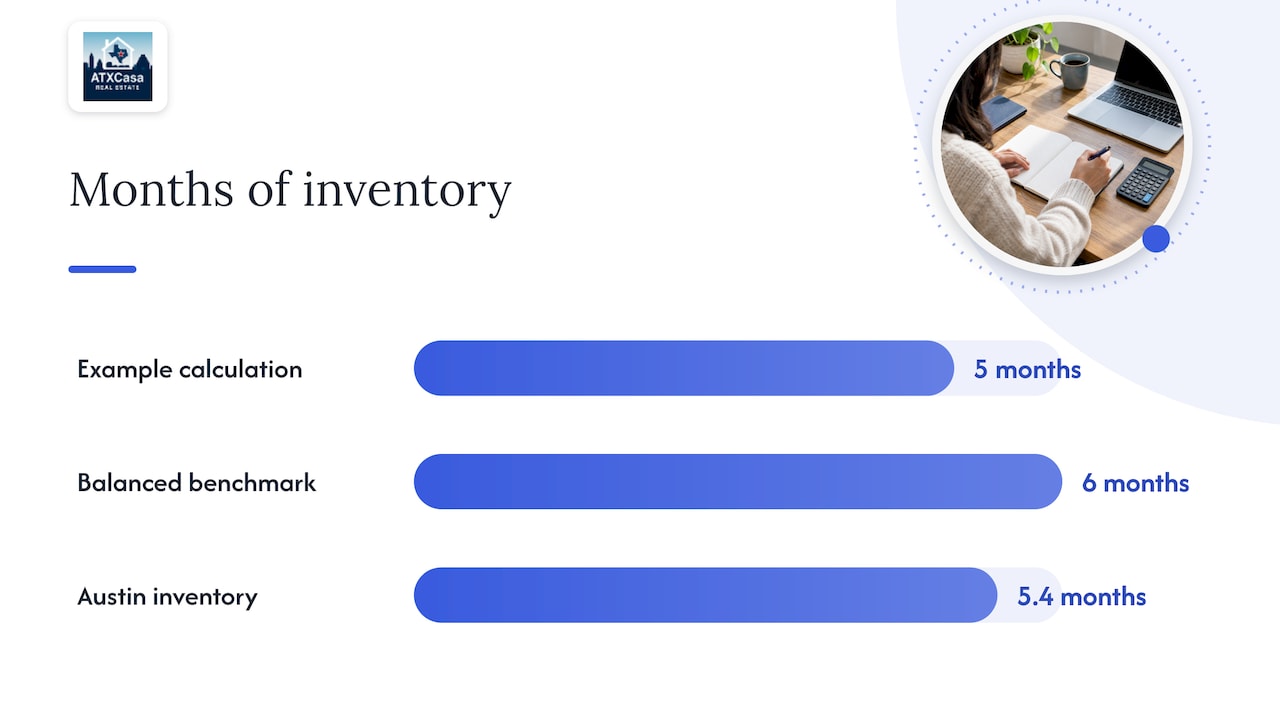
Months of inventory is a simple calculation: active listings divided by the monthly pace of closed sales. If there were 10,000 active listings and 2,000 sales a month, that would be 5 months of inventory. As a rule of thumb many agents use, roughly 6 months is balanced, less than that favors sellers and more favors buyers. At 5.4 months, Austin sits near the balanced line, but it got there from a much tighter past and with prices falling, which is why buyers currently feel more leverage than the number alone suggests.
Statewide data points the same way. The Texas Real Estate Research Center’s June 2026 snapshot showed 5.4 months of supply, 90 average days on market for active inventory, median seller price cuts of $12,000 and a 96.6% median sale-to-list ratio. A sale-to-list ratio below 100% means the typical home closes under its asking price, which is the opposite of the bidding-war years.
Is the Austin market a good value or a falling knife?
Buyers worry about this more than anything: if prices are falling, should you wait?
Forecasters expect softness to continue in places. A May 2026 report on Zillow’s outlook put Austin among the markets projected to lose the most value. The same coverage quoted Zillow’s chief economist saying friendlier conditions for buyers could produce a quick rebound if rates return to the 6% range seen earlier this year. That is the key sensitivity. Prices and rates interact: lower rates bring buyers back, and Zillow’s Skylar Olsen has said that continued mortgage-rate relief could reignite competition while many homeowners remain unmotivated to sell.
My read: trying to catch the exact bottom is a bet on two things at once, home prices and mortgage rates, and they can move in opposite directions. A buyer who waits for lower prices may find that a rate drop erases the savings by lifting demand. A buyer who waits for lower rates may face more competitors and higher prices. If you can afford the payment today and plan to stay several years, the more reliable plan is to buy while you hold leverage and revisit the rate with a refinance if rates fall later. A refinance is not guaranteed and carries closing costs, so I build the purchase to work at today’s rate.
The seasonal pattern in Austin
Season shifts how many buyers compete for each home. The pattern below is what we see working with Austin-area clients; it is a tendency, not a rule, and in a year like this one, rates and price momentum can outweigh it.
| Season | What usually happens | What it means for you |
|---|---|---|
| Spring (March to May) | The most new listings and the most buyers | Best selection, most competition, less room on price |
| Summer (June to August) | Families try to close before the school year; heat slows some showings | Good selection, moderate competition |
| Fall (September to November) | Fewer buyers per listing, sellers who did not sell in summer reconsider | A strong window for negotiating repairs and credits |
| Winter (December to February) | Fewest buyers and fewer listings | Most leverage on motivated sellers, smallest pool of homes |
What this means in practice:
- If you want the widest choice, shop in spring, but get your pre-approval done early and be ready to move quickly on well-priced homes.
- If you want the strongest negotiating position, shop from fall into winter. Homes that are still listed after the busy season often belong to sellers who have heard fewer offers than they expected.
- If your timeline is fixed (a job start, a school year, a lease ending), build backward from that date rather than from the ideal month. A reasonable purchase at the right time beats a perfect one that arrives late.
We cover the cold-weather case in more detail in when to buy a home in Austin in winter.
The monthly payment matters more than the calendar
Unlock MLS’s research advisor has urged buyers to focus on what a home price means for their monthly payment at current rates. I agree, and it is the first thing I ask clients to calculate.
The Austin payment has more pieces than principal and interest. Texas has no state income tax, but property taxes are significant. Austin Realtor Kathy Sokolic suggests relocating buyers start with lifestyle and lender conversations, then explore neighborhoods by commute, amenities, taxes and priorities. That order is sound, because two homes at the same price can carry very different tax bills depending on the jurisdiction and any special districts.
When I build a budget with a client, we list:
- Principal and interest at the quoted rate
- Property taxes for the specific address
- Homeowners insurance
- HOA dues, if any
- Utilities and routine maintenance
- Down payment, closing costs and moving costs up front
Affordability has improved. According to Redfin data reported by Spectrum News, the income needed to buy a starter home in Austin dropped by about $6,000 from 2025 to 2026, the biggest decline among the cities analyzed. Redfin’s chief economist said that because of increased supply, Austin residents have a better shot at affording the median-priced home than people in many other parts of the country.
Rent versus buy
Monthly cost is still the main barrier. Milo’s CEO told the Statesman that comparable rent is significantly less than a mortgage payment for many prospective buyers, which keeps some on the sidelines. If you are weighing the two, compare the all-in monthly cost of owning with a realistic rent for a similar home. A rent estimate and rental comps calculator helps you test what a comparable home would rent for, which is useful whether you are deciding to buy or planning to rent out a property later. Buying makes the most sense when you expect to stay long enough for equity and appreciation to offset closing costs, typically several years.
Timing by buyer type
First-time buyers
Your best timing signal is readiness: a pre-approval, a down payment, and a monthly payment you are comfortable with after taxes and insurance. With prices softer and sellers negotiating, this is a workable window. Ask for seller credits toward closing costs or a rate buydown, which can matter as much as a lower price. Our Austin homebuyer strategy guide walks through the sequence.
Families relocating to the Austin area
Start with your move date and school calendar, then narrow neighborhoods. Round Rock, Cedar Park and Georgetown each have different tax rates, commute patterns and home ages. If you are relocating from out of state, a short visit in the fall or winter lets you tour several homes in a few days when fewer buyers are competing. Our Austin housing market overview has local data to compare areas.
Investors
For investors, timing is about yield and financing, not the season. Softer prices help only if the rent covers the cost. Underwrite each property on:
- Realistic rent, tested against comparable listings
- Property taxes and insurance, which can differ sharply by address
- Vacancy and maintenance reserves
- Financing cost, since investor loans price differently from owner-occupant mortgages. If you plan a renovation, review typical fix-and-flip loan rates before you set your purchase budget.
Because listing prices have dropped and new listings are down, I look for motivated sellers and homes that have already taken price cuts, then negotiate on both price and repairs. If rates fall and competition returns, the discount on offer today may not last, so investors with ready capital have a reason to act while sellers are flexible.
Buyers who also own a home
If you need to sell before you buy, sequence matters. Our guides on when to sell your Austin home and price cuts versus closing-cost help show how sellers weigh their choices, which helps you predict what the other side of your negotiation wants.
Indicators I would watch before making an offer
You do not need a dashboard. Four numbers tell you most of what you need.
- Months of inventory. Rising supply means more leverage. Falling supply means the window is closing.
- Price reductions. The share of listings with cuts, and the size of the typical cut, show how flexible sellers are. The statewide median cut was $12,000 in June.
- Sale-to-list ratio. Below 100% means offers are typically below asking.
- Days on market for the specific home. A home that has sat for 60 days or more has a different seller than one listed last weekend.
Unlock MLS tracks these measures monthly, along with new and active listings, pending and closed sales, and median prices. I check them each month for the Austin area and for the neighborhood a client cares about, since a metro-wide number can hide a very different local story.
Perspective
At ATXCasa, we approach timing as a data problem first and a calendar question second. Our background in technology means we track inventory, price cuts and closing ratios at the neighborhood level instead of relying on a metro-wide headline.
What we tell clients is simple. Decide your maximum comfortable monthly payment, confirm it with a lender, and then watch the local indicators for homes that fit. When supply is rising and sellers are cutting prices, as they are now, a prepared buyer can negotiate on price, repairs and closing costs together. We help you price each of those and read the hidden pitfalls in a home, so that the leverage you hold shows up in your contract.
Waiting for a perfect moment usually costs more than it saves. Being ready is what lets you use a good moment.
Vladimir
How we can help you time your purchase
ATXCasa helps buyers, sellers and investors across the Austin area, including Cedar Park, Round Rock and Georgetown. We pair local market insight with data-driven pricing and personal guidance, from neighborhood trends to the problems that do not show up in listing photos.

If you want a view of a specific neighborhood, a payment estimate for your budget, or a plan for when to make an offer, reach out through ATXCasa. For more local reading, our Austin home prices outlook explains where negotiating room sits today.
FAQ
Is now a good time to buy a home in Austin?
For prepared buyers, yes. Listing prices are down about 10% from a year ago, inventory stands at 5.4 months, and sellers are cutting prices. The main risk is rates: if they fall, competition could return. Buy when the monthly payment fits your budget.
What is the best month to buy a home in Austin?
There is no single best month. Fall and winter tend to bring fewer competing buyers and more negotiating room, while spring offers the most listings. In the current market, your finances and the specific home’s price history matter more than the month.
Should I wait for Austin prices to fall further?
Forecasts suggest more softness is possible, but a rate drop could bring buyers back and lift prices quickly. If you can afford the payment now and plan to stay several years, buying while you have leverage is usually the steadier plan.
How much income do I need to buy a starter home in Austin?
Redfin data reported in August 2026 shows the required income fell by about $6,000 from 2025 to 2026, from roughly $98,664 in 2025. Your own figure depends on your down payment, rate, taxes and insurance, so ask a lender for a pre-approval.
Sources
- September 2026 Central Texas Housing Report, Unlock MLS
- Austin home prices fell 10.2%, Austin American-Statesman
- Austin home prices fall 9.8 percent, biggest drop in U.S., Houston Chronicle
- Texas Real Estate Research Center housing report
- Zillow forecast puts Austin among top market losers, Hoodline
- Zillow: Austin home market shifts in buyer’s favor, KXAN
- People looking to buy a starter home may catch a break, Spectrum News
- Kathy Sokolic on property taxes for Austin relocators, Texas Today
- Free rent estimate and rental comps calculator
- Fix and flip loan rates in 2026